Best Food for English Bulldogs: Wet, Dry or Mixed
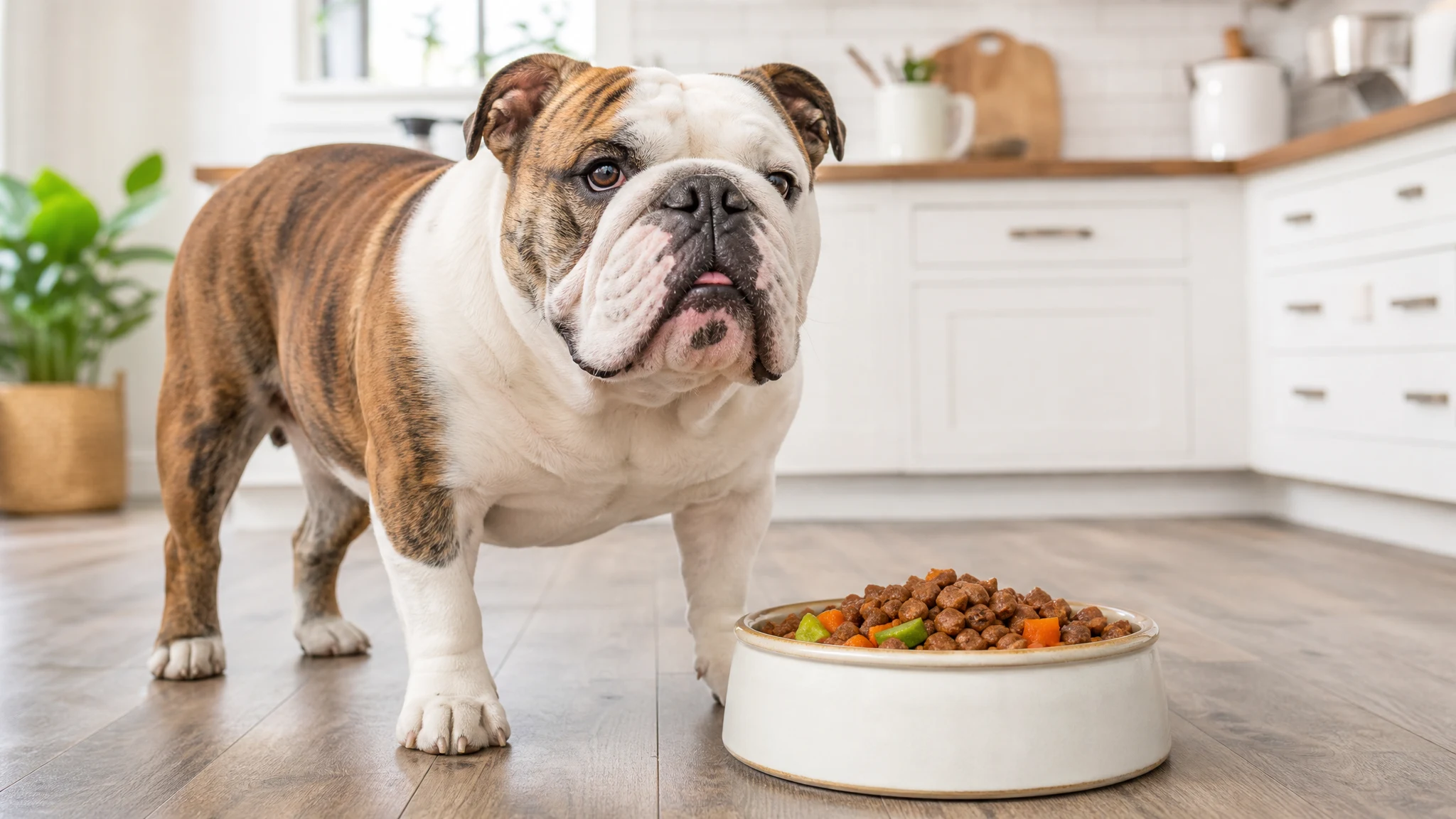
General nutrition information compiled from product labels and published sources, not veterinary advice. Your veterinarian is the right person to choose a diet for your dog, especially one with a health condition.
Choosing the best food for English Bulldogs is less about wet versus dry and more about reading the label. Both forms can be complete and balanced. What matters is the nutritional adequacy statement, the calories, and whether your dog stays lean.
This guide walks you through a simple way to decide. It uses label data only. We compared published label information from brand pages. We did not run feeding trials or taste tests, and nothing here says a food prevents or treats any condition.
Why the Breed Changes the Question
The Bulldog Club of America, in the AKC breed standard, describes mature dogs at about 50 lb and mature bitches at about 40 lb. That is a medium dog, not a large one.
PetMD says the breed is prone to obesity and that extra weight worsens other conditions. It notes that flat-faced anatomy can cause breathing difficulty and overheating, and that excess weight makes those symptoms worse. It also says extra weight aggravates hip dysplasia. PetMD gives a life expectancy of 8 to 10 years.
So the practical goal is a food you can portion accurately, in a form your dog eats comfortably, at a healthy weight. A veterinarian decides what is right for your individual dog.
Materials You Will Need
- The bag or can of any food you are considering, or its brand product page
- Your dog's current weight and your veterinarian's view of an ideal weight
- A kitchen scale or a standard 8 oz measuring cup
- A slow feeder bowl, if your dog gulps (PetMD says these can slow eating)
- A notebook or phone note to track portions, treats and weight
Step 1: Confirm the Life Stage Statement
Find the AAFCO statement on the label. It should say the food is formulated to meet the AAFCO Dog Food Nutrient Profiles for your dog's stage: growth, maintenance, or all life stages. Some brands instead say animal feeding tests substantiate the claim. Hill's Science Diet uses that wording on its pages.
Adult maintenance foods are not meant for puppies. Puppy foods are not meant for adults. Royal Canin gives two different switch points for Bulldogs. Its Bulldog Adult page describes a formula for Bulldogs 12 months and older. Its Bulldog Puppy page says to move to adult after 15 months. Ask your veterinarian which timing fits your puppy.
Step 2: Decide Between Dry, Wet or Mixed
Each form has trade-offs. None is automatically the best food for English Bulldogs.
- Dry: Easy to measure by the cup and store. Calories are concentrated, so a small scoop error adds up.
- Wet: Mostly water, so the same weight of food carries fewer calories. Label amounts are usually given per can, which makes counting simple but can get costly in volume.
- Mixed: Dry as the base with some wet on top. It works if you count the calories from both and reduce the dry portion to match.
Wet food is not a weight-loss tool by itself. It only helps if total daily calories fall.
Step 3: Compare Labels Side by Side
Use the same measures for every food. The table below shows label data from brand pages. Note the different bases. Royal Canin lists guaranteed analysis as fed. Hill's lists dry matter averages, which are not guaranteed minimums and cannot be compared directly with as-fed numbers.
| Food | Form and stage | Protein and fat | Calories | First ingredients |
|---|---|---|---|---|
| Royal Canin Bulldog Adult | Dry, adult Bulldogs 12 months and older | 22.0% min protein, 12.0% min fat (as fed) | 277 kcal ME per cup | Brewers rice, oat groats, chicken by-product meal, brown rice, wheat gluten |
| Royal Canin Bulldog Puppy | Dry, growth | 28.0% min protein, 15.0% min fat (as fed) | 338 kcal ME per cup | Chicken by-product meal, brewers rice, brown rice, chicken fat, wheat gluten |
| Royal Canin French Bulldog Loaf in Sauce | Wet, adult French Bulldogs (not an English Bulldog formula) | 6.7% min protein, 3.4% min fat (as fed) | 70 kcal ME per 3 oz can | Water, pork by-products, chicken, chicken by-products, powdered cellulose |
| Hill's Science Diet Adult Chicken & Barley Entree | Wet, adult maintenance, ages 1 to 6 | 26.7% protein, 16.7% fat (dry matter averages) | 369 kcal per 13 oz can | Water, chicken, pork liver, whole grain corn, cracked pearled barley |
The Royal Canin Bulldog formulas are the only breed-named options in this comparison. The French Bulldog loaf is included only as a flat-faced-breed wet example. For a wider comparison, see our foods compared by label.
A note on large breed formulas
Some Hill's Science Diet foods are labelled "Large Breed" for adults of 55 lb or more. English Bulldogs are usually 40 to 50 lb, so these are not made for the breed. The Hill's Perfect Weight Large Breed dry food lists 289 kcal per cup, which is why it sometimes comes up for weight management. Ask your veterinarian before using a size-mismatched food.
Step 4: Set a Starting Portion
Use the feeding guide on the label as a starting point only. Royal Canin's Bulldog Adult page, for example, lists a 40 lb dog at low activity at 2 7/8 cups (219 g) per day. Hill's tells owners to adjust amounts to maintain optimal weight and to ask a veterinarian if unsure.
PetMD advises basing portions on ideal weight, not current weight. If your dog is overweight, ask your veterinarian for a target before you rely on the chart. Split the daily amount into two meals, which is PetMD's advice for adults.
Step 5: Build a Mixed Plan, If You Choose One
- Start with the daily calorie amount you and your veterinarian settled on.
- Pick the wet portion first, using calories per can from the label.
- Subtract those calories from the daily total.
- Fill the rest with dry food, using calories per cup.
As an illustration of the label math, a 3 oz can listed at 70 kcal is about a quarter of a cup of a dry food listed at 277 kcal per cup. Different brands and formulas will not swap this neatly, so check each label.
Step 6: Switch Foods Gradually
Change foods over several days by mixing a little of the new food into the old and increasing it slowly. Brand labels often give their own switching schedule. Follow it and ask your veterinarian if your dog has a sensitive stomach.
Change only one thing at a time. If you swap food and treats together, you will not know what caused any problem.
Step 7: Track Weight and Adjust
Weigh your dog regularly and keep notes. Treats should be no more than 10% of daily calories, according to PetMD. Count chews, dental treats and food used in training.
If weight creeps up, reduce portions slightly and recheck with your veterinarian. Do not cut food drastically on your own.
Tips
- Weigh food in grams if you can. Cup scoops vary a lot.
- Warm wet food slightly if your dog is picky, but let it cool before serving.
- Use a slow feeder bowl if meals vanish in seconds.
- Keep skin folds clean and dry. PetMD notes that trapped moisture encourages infection, and this is a care issue, not a diet one.
- If your dog has itchy skin or ear trouble, talk to your veterinarian. PetMD says food allergies can cause skin problems and some dogs need a special diet. Prescription diets are something only a veterinarian prescribes.
Common Mistakes to Avoid
- Judging by the front of the bag. Marketing words are not label data. Read the AAFCO statement and the ingredient list.
- Comparing different bases. As-fed and dry matter numbers are not interchangeable.
- Stacking wet food on a full dry portion. This quietly adds calories.
- Feeding a puppy food too long, or an adult food too early. Check the stage on the label.
- Choosing a food because of a diet-DCM headline. The FDA's last public update on its diet-DCM investigation was December 23, 2022, and the agency says report counts alone do not establish a causal link. Ask your veterinarian about any concern.
What to Expect
With steady portions and tracked treats, many owners find it easier to keep their dog at a stable weight. A well-matched food may also make mealtimes simpler and stools more consistent. Results vary by dog, and no food can promise a particular outcome for breathing, joints or skin.
If your dog loses appetite, vomits, has ongoing loose stools or gains weight despite careful portions, contact your veterinarian. For specific formulas, confirm current label details on the brand's own page, since recipes and statements change.
Sources
- Bulldog Club of America, AKC Bulldog Breed Standard
- PetMD, Bulldog breed page
- FDA CVM, Investigation into Potential Link between Certain Diets and Canine Dilated Cardiomyopathy
- Royal Canin US, Bulldog Adult
- Royal Canin US, Bulldog Puppy
- Royal Canin US, French Bulldog Loaf in Sauce
- Hill's Pet, Science Diet Adult Chicken & Barley Entree
- Hill's Pet, Science Diet Adult Perfect Weight Large Breed