How Much Should an English Bulldog Eat? Puppy, Adult and Senior Amounts
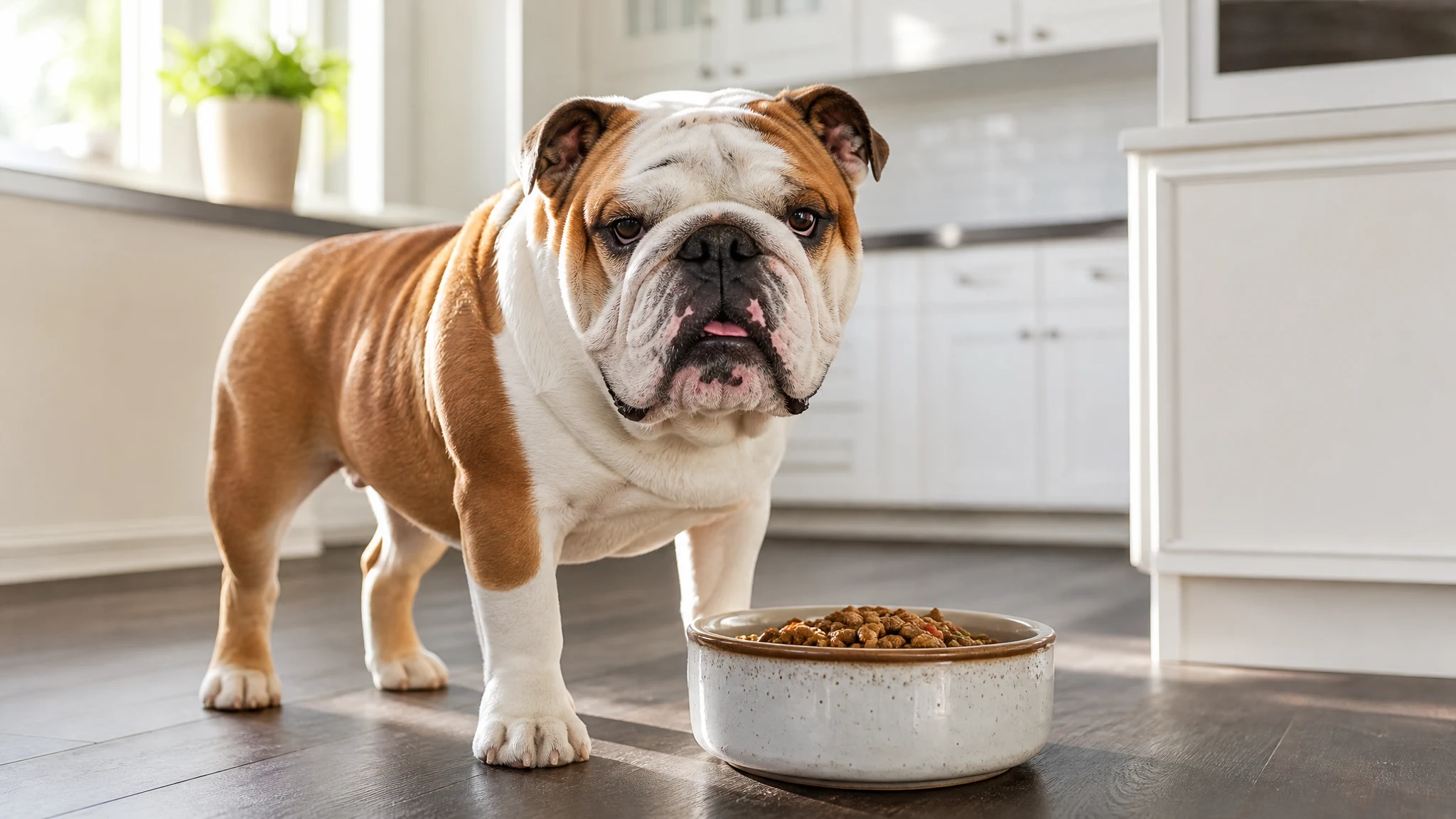
General nutrition information compiled from product labels and published sources, not veterinary advice. Your veterinarian is the right person to choose a diet for your dog, especially one with a health condition.
There is no single cup measure that fits every English Bulldog. The right amount depends on the food's calories, your dog's age, ideal weight and activity. This guide shows how to find a sensible starting amount from the label, then adjust it with your veterinarian.
The English Bulldog is a medium breed. The Bulldog Club of America, citing the AKC breed standard, gives about 50 lb for mature dogs and about 40 lb for mature bitches. PetMD gives a similar range of roughly 40 to 50 lb.
Why portions matter so much for this breed
PetMD lists obesity as a common concern in Bulldogs, and says extra weight makes other problems worse. That includes breathing trouble from the flat-faced anatomy (brachycephalic obstructive airway syndrome) and strain on the hips.
Food does not prevent or treat any of these conditions. Portion control is one part of keeping a dog lean, and a veterinarian decides what is right for an individual dog.
What you need
- The food's bag or can label, with the calorie statement and feeding guide.
- A kitchen scale (grams are more reliable than a scooped cup).
- A standard 8 oz measuring cup if you do not weigh the food.
- Your dog's current weight and the ideal weight your veterinarian suggests.
- A notebook or phone note to log meals, treats and weigh-ins.
- Optional: a slow feeder bowl. PetMD notes these can slow down fast eaters.
Step-by-step: finding your Bulldog's starting amount
1. Confirm the life stage on the label
Look for the nutritional adequacy statement. It should say the food is formulated to meet the AAFCO Dog Food Nutrient Profiles for growth, maintenance or all life stages. A puppy needs a growth or all-life-stages food. An adult can eat a maintenance or all-life-stages food.
The English Bulldog is well under 70 lb as an adult. The AAFCO wording about large-size dog growth (70 lb or more as an adult), as explained by Whole Dog Journal, is therefore not a requirement for this breed.
2. Decide whether your dog is a puppy or an adult
Manufacturers do not agree on the switch age. The Royal Canin Bulldog Adult page describes its formula for Bulldogs 12 months and older. The Royal Canin Bulldog Puppy page says to move to adult food after 15 months. Ask your veterinarian which timing suits your dog.
3. Find the calories on the label
Calories per cup vary a lot between foods. Royal Canin lists Bulldog Adult dry food at 277 kcal ME per cup and Bulldog Puppy dry food at 338 kcal ME per cup (both calculated, as fed). A cup of one food is not a cup of another, so never reuse an old scoop size when you change brands.
4. Read the feeding guide for your dog's ideal weight
PetMD advises basing portions on ideal weight, not current weight. Royal Canin's Bulldog Adult table lists, for example, 2 7/8 cups (219 g) a day for a 40 lb dog at low activity. Treat that as a starting point, not a target.
5. Split the day into meals
PetMD suggests feeding adults twice daily. Divide the daily amount into two measured meals. For puppies, the Royal Canin Bulldog Puppy guide is organized by puppy age and expected adult weight, so use the row that matches your dog.
6. Count the treats
PetMD recommends treats make up no more than 10% of daily calories. Reduce the meal amount a little on days with extra treats, training rewards or chews.
7. Weigh, check and adjust every two to four weeks
Weigh your dog and feel the ribs. You should be able to feel them without pressing hard. If weight creeps up, trim the daily amount slightly and tell your veterinarian. Do not make large cuts on your own, especially in a growing puppy.
Puppy, adult and senior: what the labels say
Puppies
Puppies eat more per pound than adults, and growth foods are denser in calories. Royal Canin's Bulldog Puppy food lists a guaranteed analysis of 28% protein minimum and 15% fat minimum, as fed, with 338 kcal ME per cup. The listed first ingredients are chicken by-product meal, brewers rice, brown rice, chicken fat and wheat gluten. Its statement says it is formulated to meet AAFCO profiles for growth.
Adults
Royal Canin's Bulldog Adult food lists 22% protein minimum and 12% fat minimum, as fed, at 277 kcal ME per cup. Its first ingredients are brewers rice, oat groats, chicken by-product meal, brown rice and wheat gluten.
If you feed canned food, read the can size. Hill's Science Diet Adult Chicken & Barley Entree lists 369 kcal per 13 oz can, and its chart shows a 50 lb dog at 3 1/4 cans a day. That is a lot of cans, so many owners mix wet and dry food and cut the dry portion to match.
Seniors
We could not find a breed-specific senior portion from the Bulldog Club of America or a manufacturer. PetMD gives a life expectancy of 8 to 10 years, but it does not say when a Bulldog should switch to a senior diet. Ask your veterinarian when to change foods and how many calories your older dog needs, since activity and weight often change with age.
For a label example only, Freshpet's Healthy Senior Chicken Recipe lists 21 to 40 lb dogs at 1 to 1 1/2 lb per day. Its statement says all life stages, so "senior" there is marketing, not an AAFCO category.
A label comparison, not a taste test
The table below compares label data only. We did not run feeding trials or taste tests. The Hill's figures are dry-matter averages, not guaranteed minimums, so do not compare them directly with the as-fed numbers.
| Food | AAFCO statement | Protein / fat | Calories | First ingredients |
|---|---|---|---|---|
| Royal Canin Bulldog Puppy (dry) | Growth | 28% min / 15% min, as fed | 338 kcal per cup | Chicken by-product meal, brewers rice, brown rice, chicken fat, wheat gluten |
| Royal Canin Bulldog Adult (dry) | Maintenance | 22% min / 12% min, as fed | 277 kcal per cup | Brewers rice, oat groats, chicken by-product meal, brown rice, wheat gluten |
| Hill's Science Diet Adult Chicken & Barley (canned) | Maintenance, by feeding tests | 26.7% / 16.7%, dry-matter average | 369 kcal per 13 oz can | Water, chicken, pork liver, whole grain corn, cracked pearled barley |
| Freshpet Home Cooked Chicken (fresh) | Adult maintenance | 15% min / 11% min, as fed | 189 kcal per cup | Chicken, eggs, cranberries, carrots, ground oats |
For a wider look at more foods, see our label-by-label comparison of foods for English Bulldogs.
Tips and common mistakes
- Using a scoop that came with another food. Calories per cup differ, so measure fresh with each new food.
- Feeding by current weight when the dog is overweight. Use the ideal weight, as PetMD advises.
- Forgetting treats and chews. Count them in the 10% limit.
- Treating the chart as a rule. Hill's own pages say to adjust amounts to maintain optimal weight and to ask your veterinarian if unsure.
- Switching foods suddenly. Change gradually over several days and watch your dog's stool and appetite.
- Using a flat-faced formula as an English Bulldog formula. Royal Canin's French Bulldog loaf is made for a different breed. Check with the brand before using it.
- Picking a food for a disease. If your dog has skin problems, allergies or joint trouble, PetMD says some dogs need a special diet. Only a veterinarian can decide that, and prescription diets come from a veterinarian.
What to expect
With measured meals and regular weigh-ins, many owners find it easier to keep a Bulldog at a lean, comfortable weight. Results vary by dog, and no amount of food can promise a particular outcome. Keeping weight in check may ease strain on breathing and joints, according to PetMD's description of how extra weight worsens these problems, but your veterinarian should guide any changes.
If your dog loses or gains weight quickly, seems hungry all the time, or has trouble breathing, call your veterinarian. The FDA's investigation into diet and canine dilated cardiomyopathy has not been updated publicly since December 23, 2022, and it notes that report counts alone do not prove a link. Ask your veterinarian if you have questions about your dog's diet.
Sources
- Bulldog Club of America, AKC Bulldog Breed Standard
- PetMD, Bulldog breed page
- Royal Canin US, Bulldog Adult
- Royal Canin US, Bulldog Puppy
- Hill's Pet, Science Diet Adult Chicken & Barley Entree
- Freshpet, Home Cooked Chicken Recipe
- Freshpet, Healthy Senior Chicken Recipe
- Whole Dog Journal, In the Fine Print: Nutritional Adequacy Statements
- FDA CVM, Investigation into Potential Link between Certain Diets and Canine Dilated Cardiomyopathy