Wet vs Dry vs Fresh Food for English Bulldogs
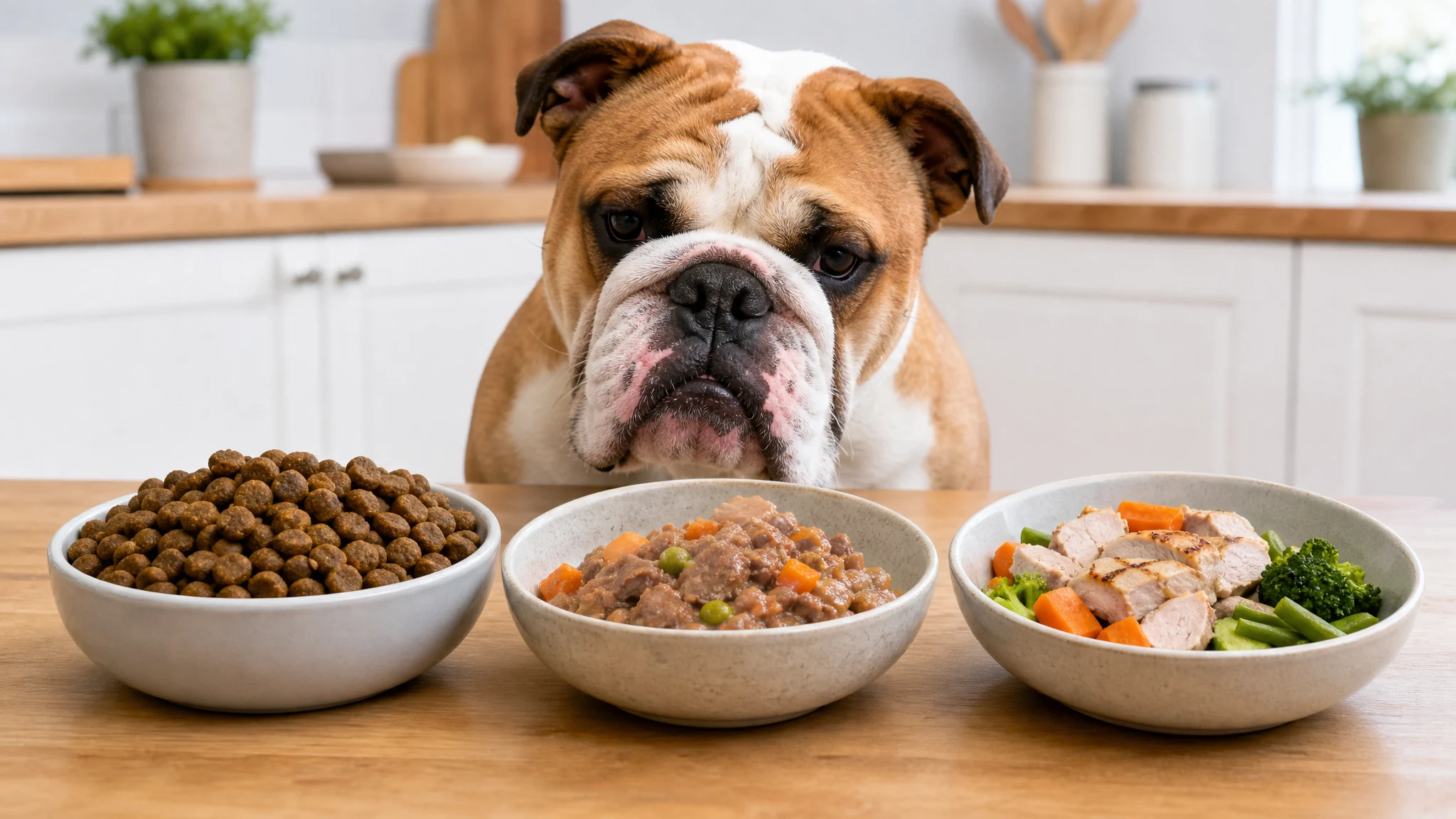
General nutrition information compiled from product labels and published sources, not veterinary advice. Your veterinarian is the right person to choose a diet for your dog, especially one with a health condition.
Wet, dry and fresh foods all claim to suit an English Bulldog. They differ in water content, calories per scoop, cost and how easy they are to measure. Those differences matter for a breed that tends to gain weight.
This page compares the three forms using label data only. We compared published label information from the brands. We did not run feeding trials or taste tests, and nobody here fed these foods to a dog. Treat everything below as a way to read labels, not as a ruling on a brand.
Why the form of the food matters for this breed
The Bulldog Club of America's breed standard describes a medium dog of about 50 lb for mature males and about 40 lb for mature females. PetMD gives a similar range of roughly 40 to 50 lb.
PetMD also lists obesity as a breed tendency and says extra weight makes other problems worse. Those include the breathing trouble linked to the flat face (brachycephalic obstructive airway syndrome) and hip dysplasia. So the practical question is not only which food tastes best. It is which form lets you measure calories accurately and keep your dog lean.
PetMD's feeding advice for the breed is simple. Feed adults twice a day, base portions on ideal weight, and keep treats to no more than 10% of daily calories. It also notes that slow feeder bowls can slow down fast eaters. A veterinarian decides what is right for an individual dog.
Wet vs dry dog food at a glance
The comparison of wet vs dry dog food starts with water. Canned food lists water as its first ingredient. Dry food does not, so the same protein number means different things on each label.
| Attribute | Dry | Wet (canned) | Fresh |
|---|---|---|---|
| Moisture | Low. Water is not among the first five ingredients on the dry labels compared. | High. Water is the first ingredient on the canned labels compared. | High. Lists real foods such as chicken, eggs or vegetables first. |
| Calories, example label | Royal Canin Bulldog Adult: 277 kcal per cup | Hill's Science Diet Adult Chicken & Barley: 369 kcal per 13 oz can | Freshpet Home Cooked Chicken: 189 kcal per cup. Nom Nom Chicken Cuisine: 244 kcal per cup |
| Protein on the label | 22% as fed (Royal Canin Bulldog Adult) | 6.7% as fed (Royal Canin French Bulldog loaf) | 15% as fed (Freshpet Home Cooked Chicken); 6.5% as fed (Nom Nom) |
| Measuring | Cups or grams, with a feeding table | Cans, with a feeding table | Daily amount by weight, or a brand calculator |
| Cost per day | Generally the lowest of the three | Generally higher than dry when it is the whole diet | Generally the highest |
| Bulldog-specific option | Yes, Royal Canin Bulldog Adult and Puppy | Not an English Bulldog formula in the label data compared | None named for the breed |
The protein figures are not directly comparable. The Royal Canin and Freshpet numbers are as fed. Hill's publishes dry-matter averages for its wet food (26.7% protein), which have the water removed. A canned food showing 6.7% as fed can carry similar protein to a dry food once the water is accounted for.
Dry food
Dry food is the form with the most breed-specific choices. Royal Canin makes a Bulldog Adult formula for purebred Bulldogs 12 months and older. It lists brewers rice, oat groats, chicken by-product meal, brown rice and wheat gluten first. Its label analysis is 22% protein minimum, 12% fat minimum and 4.1% fiber maximum, with 277 kcal ME per cup.
The Royal Canin Bulldog Puppy formula covers 8 weeks to 15 months. It has 28% protein, 15% fat and 338 kcal ME per cup. The brand's two pages give different switch ages for the move to adult food: 12 months and older on the adult page, and after 15 months on the puppy page. Ask your veterinarian which fits your dog.
Pros of dry food
- Easy to measure by the cup or by weight.
- Feeding tables are printed by weight, so a starting amount is simple to find. Royal Canin lists 2 7/8 cups (219 g) a day for a 40 lb dog at low activity. Treat that as a starting point, not a target.
- Usually the lowest cost per day, in general terms.
- Works well in puzzle toys and slow feeders.
Cons of dry food
- Calories are packed into each cup, so a heavy scoop adds up fast. Hill's Adult Large Breed is listed at 390 kcal per cup, while Hill's Perfect Weight Large Breed is 289 kcal per cup. Cup sizes alone tell you little.
- Kibble size matters for a short-faced dog, and the label data does not settle it. The Royal Canin pages describe a wave-shaped kibble but do not state a size. Check with the brand before assuming it suits a flat-faced mouth.
- Less water in the bowl.
Wet food for English Bulldogs
People often ask about wet food for English Bulldogs because it is soft and strongly flavored. The label data makes the tradeoffs clear.
The canned products compared are the Hill's Science Diet Adult Chicken & Barley Entree and the Royal Canin French Bulldog Loaf In Sauce. The Royal Canin loaf is made for French Bulldogs, a different breed. It is a flat-faced breed option, not an English Bulldog formula. The Hill's canned food is a standard adult food for ages 1 to 6, not for puppies, pregnant or nursing dogs, or mature adults.
Pros of wet food
- High water content, since water leads the ingredient list.
- Soft texture, which some owners prefer.
- Cans are single-use portions, which can make counting easier.
Cons of wet food
- Calories per can are easy to mismanage. The Royal Canin loaf is 70 kcal per 3 oz can. The Hill's can is 369 kcal for 13 oz.
- As a whole diet, it takes a lot of cans. Hill's chart gives a 50 lb dog 3 1/4 of its 13 oz cans a day. That is a lot of cans to open, store and pay for.
- Cost per day generally runs above dry food when canned food is the whole diet.
Fresh dog food for English Bulldogs
Fresh dog food for English Bulldogs is the newest category. The brands in this comparison are Freshpet, Nom Nom and JustFoodForDogs. None of them lists a Bulldog-specific recipe, so these are general adult or all-life-stage foods.
- Freshpet Fresh From the Kitchen Home Cooked Chicken: the label says it is formulated to meet AAFCO levels for adult maintenance. It lists chicken, eggs, cranberries, carrots and ground oats first, with 189 kcal per cup.
- Freshpet Healthy Senior Chicken Recipe: marketed to seniors, though its statement says all life stages. It is 255 kcal per half pound.
- Nom Nom Chicken Cuisine: formulated for all life stages, including growth of large-size dogs (70 lb or more as an adult). That large-size wording does not apply to an adult English Bulldog. The ingredient list shows no grains, though the brand does not call it grain-free. It has 244 kcal per cup.
- JustFoodForDogs Pantry Fresh Chicken & Rice: a pouch for all life stages with 31 kcal ME per ounce, or 387.5 kcal ME per 12.5 oz pouch. Its feeding guide is a calculator on the page, not a printed table.
Pros of fresh food
- Short ingredient lists led by recognizable foods such as chicken, rice and vegetables.
- Feeding guides built around your dog's weight.
- Some labels state a full-meal feeding approach, so you do not have to build a diet yourself.
Cons of fresh food
- Generally the highest cost per day of the three forms.
- Calorie density varies a lot between brands, from 189 to 244 kcal per cup in the two examples, and the Healthy Senior recipe is listed per half pound with no cup value.
- Pet owners often assume fresh means healthier. The label statements we compared show the same kind of AAFCO claim as the other forms.
- Kibble size is not an issue here, but chew and bite-size questions are best put to the brand.
Three myths worth checking
Dental myths
A common belief is that dry food cleans teeth and wet food ruins them. None of the label data compared makes a dental claim, and no source behind this page backs either side. Whether a food helps or harms an individual dog's mouth is a question for your veterinarian.
The "complete and balanced" label
Every product compared carries an AAFCO statement, but the wording differs. Hill's states that animal feeding tests using AAFCO procedures substantiate its claim. The Royal Canin, Freshpet and Nom Nom statements say the food is formulated to meet the AAFCO nutrient profiles. Both are accepted routes, and the label tells you which one a brand used.
Big-breed labels
Hill's Large Breed foods are labelled for dogs 55 lb or more as adults. That is above the English Bulldog's usual weight. They appear in label comparisons because of their weight-management or joint marketing, not because they are made for Bulldogs. Nothing here shows a food prevents hip dysplasia or any other condition.
Can you mix wet, dry and fresh?
Mixing is common, and none of the labels compared forbids it. The rule that matters is arithmetic. Each product's feeding guide assumes it is the whole diet, so adding a topper on top of a full portion adds calories. If you mix, reduce each portion and add the calories together.
Nom Nom's page, for example, points to its feeding guide for a full-meal diet. A split diet needs your own math. Your veterinarian can help set a daily calorie target for your dog's ideal weight, and PetMD's 10% limit on treats applies to anything that is not part of the main meal.
Best for: choosing by use case
- Tight weight control and precise portions: dry food, measured by weight on a kitchen scale.
- Puppy growth: a puppy-labelled food. Royal Canin Bulldog Puppy is the only Bulldog-specific puppy label in this comparison. Large-breed puppy foods carry a size rule that does not apply to a 40 to 50 lb breed.
- Dogs that are picky or slow to eat: wet or fresh food as a topper, with the main portion reduced to match.
- Dogs with skin or food-allergy questions: talk to a veterinarian first. PetMD says some dogs with allergies need a special diet, and prescription diets come only from a veterinarian.
- Tight budgets: dry food, with a smaller amount of wet or fresh as an occasional addition.
- Owners who want less measuring: fresh food with a printed guide, if the budget allows.
The verdict
For most English Bulldog households, dry food is the practical default. It is the easiest form to measure, usually the cheapest per day, and the only form with a Bulldog-specific adult and puppy formula in the label data we compared.
Wet and fresh foods are reasonable choices, especially as a topper or for a picky eater. Their drawbacks are cost and calorie math. A can or a scoop of fresh food is not automatically lighter than kibble.
No form is a clear winner on health. The best choice is the one that keeps your dog lean, fits your budget and suits your dog's vet-checked needs. Because we compared labels and did not feed any of these foods, confirm kibble size, cup weight and current ingredients with the brand and your veterinarian before switching.
To see the individual products side by side, read our English Bulldog foods compared by label.
Sources
- Bulldog Club of America, AKC Bulldog Breed Standard
- PetMD, Bulldog breed page
- Royal Canin US, Bulldog Adult
- Royal Canin US, Bulldog Puppy
- Royal Canin US, French Bulldog Loaf In Sauce
- Hill's Pet, Science Diet Adult Chicken & Barley Entree
- Hill's Pet, Science Diet Adult Large Breed
- Hill's Pet, Science Diet Adult Perfect Weight Large Breed
- Freshpet, Home Cooked Chicken Recipe
- Freshpet, Healthy Senior Chicken Recipe
- Nom Nom, Chicken Cuisine
- JustFoodForDogs, Pantry Fresh Chicken & Rice