What Makes a Food Good for an English Bulldog? A Label-Reading Guide
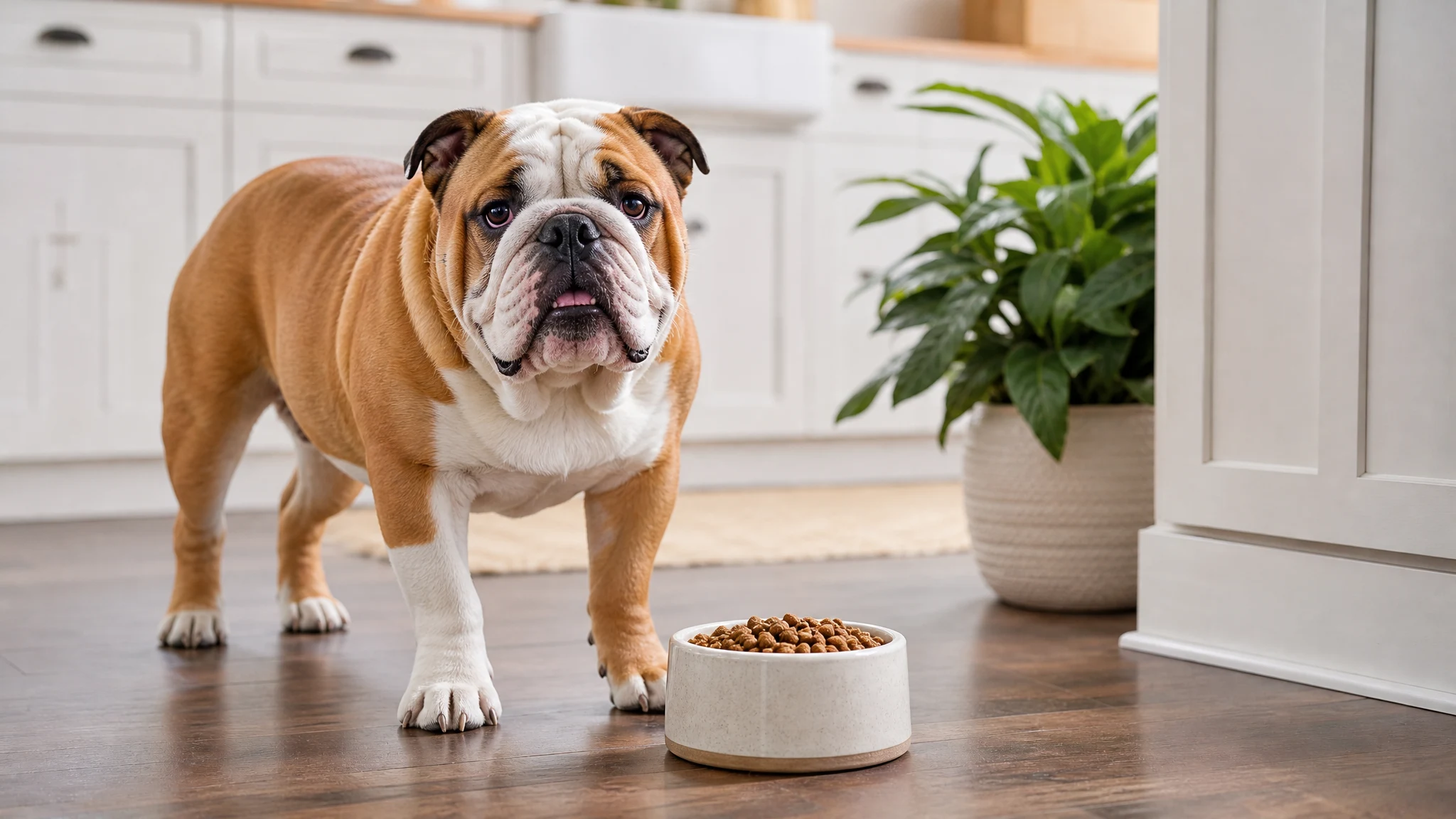
General nutrition information compiled from product labels and published sources, not veterinary advice. Your veterinarian is the right person to choose a diet for your dog, especially one with a health condition.
Pet food marketing is loud. Photos of roast chicken, words like "premium" and "natural," and a bulldog silhouette on the bag tell you very little. The label tells you more. This guide shows how to read it step by step, so you can judge good food for English Bulldogs on evidence instead of packaging.
A note on method: we compared label data published by the brands. We did not run feeding trials or taste tests, and we are not rating how any food performs in a real dog. A label can tell you what a food is built to be. Your veterinarian decides what suits your individual dog.
Why the English Bulldog needs a closer look
The Bulldog Club of America, which publishes the AKC Bulldog breed standard, describes a medium breed at about 50 lb for mature dogs and about 40 lb for mature bitches. PetMD gives a similar range of roughly 40 to 50 lb. That matters, because some "large breed" labels are written for dogs well above that weight.
PetMD also lists several diet-related concerns for the breed. Bulldogs are prone to obesity. Flat-faced anatomy can cause breathing trouble and overheating, and extra weight makes those symptoms worse. Extra weight also aggravates hip dysplasia. Some dogs with food, flea or environmental allergies need a special diet, which is a veterinary decision.
So a good label, for this breed, is one that helps you feed a lean dog the right amount of a complete food. No label can promise more than that.
What you need before you start
- The bag, can or product page for each food you are considering
- Your dog's current weight and age
- A kitchen scale or a standard measuring cup
- A notepad or spreadsheet for side-by-side notes
- Your veterinarian's view of your dog's ideal weight
Step 1: Find the AAFCO nutritional adequacy statement
Look for a sentence saying the food is "formulated to meet the nutritional levels established by the AAFCO Dog Food Nutrient Profiles" or that feeding tests "substantiate" complete and balanced nutrition. The two wordings are different. Formulated means the recipe was designed to meet the profile. Feeding tests means the brand ran trials using AAFCO procedures.
Hill's Science Diet, for example, uses the feeding-test wording on its adult and puppy pages. Royal Canin's Bulldog pages use the "formulated to meet" wording. Neither wording is proof of how your dog will do, but a food with no such statement is not a complete diet.
Step 2: Match the life stage
The statement names a life stage: growth, maintenance, or all life stages. Choose the one that fits your dog.
Brands disagree on when a Bulldog becomes an adult. Royal Canin's Bulldog Adult page describes a formula for Bulldogs 12 months and older, while its Bulldog Puppy page says to move to adult after 15 months. If your dog is near that window, ask your veterinarian when to switch.
Step 3: Check the large-breed wording
Whole Dog Journal explains that a food labelled for growth "including growth of large-size dogs (70 pounds or more as an adult)" suits large-breed puppies, while one labelled "except for growth of large-size dogs" should not be fed to them. Smaller-breed puppies can eat either. An adult English Bulldog at 40 to 50 lb is well under 70 lb, so that threshold does not apply to the breed.
Hill's "Large Breed" foods are labelled for dogs of 55 lb or more as adults. They are not made for Bulldogs. Treat them as size-adjacent options at most, and ask your veterinarian before choosing one.
Step 4: Read the first five ingredients
Ingredients are listed by weight before cooking, so the first few tell you the base of the recipe. Note what they are, and do not read too much into any single name. "Chicken by-product meal" is a real ingredient category, not automatically good or bad. "Wheat gluten" or "brown rice" tells you the grain content, nothing more.
If your dog has been diagnosed with a food allergy, the ingredient list is where your veterinarian's elimination plan gets applied. Do not guess on your own.
Step 5: Compare protein, fat and calories on the same basis
This is where labels trip people up. Some brands publish guaranteed analysis as fed. Hill's publishes dry-matter averages, which are not guaranteed minimums. A dry food and a canned food cannot be compared from those numbers directly. Always check which basis a figure uses.
Calories per cup matter most for a breed that gains weight easily. Two foods can look alike but differ by more than 100 kcal per cup.
| Food (brand page) | Life stage | Protein | Fat | Calories | First ingredients |
|---|---|---|---|---|---|
| Royal Canin Bulldog Adult, dry | Maintenance | 22% min, as fed | 12% min, as fed | 277 kcal ME per cup | Brewers rice, oat groats, chicken by-product meal |
| Royal Canin Bulldog Puppy, dry | Growth | 28% min, as fed | 15% min, as fed | 338 kcal ME per cup | Chicken by-product meal, brewers rice, brown rice |
| Hill's Science Diet Adult Perfect Weight Large Breed, dry | Maintenance | 28.8%, dry matter average | 11.2%, dry matter average | 289 kcal per cup | Chicken, cracked pearled barley, brown rice |
| Hill's Science Diet Adult Large Breed, dry | Maintenance | 23.8%, dry matter average | 16.3%, dry matter average | 390 kcal per cup | Chicken, brown rice, brewers rice |
Read the table with care. The Royal Canin figures are as fed, and the Hill's figures are dry matter, so the protein and fat columns are not directly comparable between brands. The calorie column is the easier comparison, and it shows how widely cup-for-cup energy can differ.
For a longer side-by-side, see our label comparison of foods for English Bulldogs.
Step 6: Treat the feeding guide as a starting point
Every label has a feeding table. Use it as a first estimate, then adjust. PetMD advises basing portions on ideal weight, feeding adults twice daily, and keeping treats to no more than 10% of daily calories. Hill's own pages say to adjust amounts as necessary to maintain optimal weight, and to ask your veterinarian if unsure.
For example, Royal Canin's Bulldog Adult page lists a daily table by weight and activity level. It shows a 40 lb dog at low activity at 2 7/8 cups (219 g). Treat that as a label guide, not a prescription. Weigh the portion rather than eyeballing a scoop, and recheck your dog's body condition every few weeks.
Step 7: Consider the format
Dry, canned and fresh foods can all carry complete-and-balanced statements. The differences are on the label: moisture, calories per cup or per can, and how portions are measured. Royal Canin's canned loaf for French Bulldogs lists 70 kcal ME per 3 oz can. It is a French Bulldog formula, not an English Bulldog formula, so it is only an example of a flat-faced-breed wet food.
PetMD notes that slow feeder bowls can slow eating. That is a feeding-habit tip, not a label feature.
Step 8: Ask about grain-free and DCM headlines
You may see worry about grain-free diets and heart disease. The FDA's last public update on its investigation into diets and canine dilated cardiomyopathy was December 23, 2022. The agency says report counts alone do not establish a causal link, and that it does not plan more public updates until there is meaningful new scientific information. The foods listed above are not labelled grain-free. If you are weighing this question, check the FDA page and ask your veterinarian.
Tips and common mistakes
- Trusting the bulldog on the bag. Breed art is marketing. Read the statement and the numbers.
- Comparing mismatched numbers. As-fed and dry-matter figures are different measures.
- Ignoring calories. A "healthy" food still adds weight if the cup is too big.
- Using a large-breed puppy food by default. The 70 lb rule does not apply to this breed.
- Switching all at once. Change foods gradually over several days and ask your veterinarian how.
- Expecting a food to fix a condition. Diet is one part of care. Allergies, joint problems and breathing issues need a veterinarian. Prescription diets are only something a veterinarian prescribes.
- Forgetting the folds. PetMD notes that skin fold infections come from trapped moisture. Cleaning and drying the folds matters more than any ingredient.
What to expect
If you choose a complete food that fits your dog's life stage and measure portions against ideal weight, you may find it easier to keep your Bulldog lean. A lean dog may be more comfortable and may put less strain on joints and breathing, according to PetMD. Results vary from dog to dog, and no food can be expected to prevent or treat any condition.
Check in with your veterinarian about weight and body condition, and ask before changing foods if your dog has any health issue. Because PetMD notes the breed's typical life expectancy as 8 to 10 years, steady weight management over the long run is a reasonable goal to discuss.
Quick checklist
- Find the AAFCO statement and note its wording.
- Match life stage to your dog.
- Ignore large-breed claims unless your veterinarian advises otherwise.
- Read the first five ingredients.
- Compare protein, fat and calories on the same basis.
- Weigh portions and treat the guide as a starting point.
- Confirm choices with your veterinarian.
Sources
- Bulldog Club of America, AKC Bulldog Breed Standard
- PetMD, Bulldog breed page
- Whole Dog Journal, In the Fine Print: Nutritional Adequacy Statements
- FDA CVM, Investigation into Potential Link between Certain Diets and Canine Dilated Cardiomyopathy
- Royal Canin US, Bulldog Adult
- Royal Canin US, Bulldog Puppy
- Royal Canin US, French Bulldog Loaf In Sauce
- Hill's Pet, Science Diet Adult Perfect Weight Large Breed
- Hill's Pet, Science Diet Adult Large Breed No Corn, Wheat, Soy