Best Dry Food for English Bulldogs on a Budget
General nutrition information compiled from product labels and published sources, not veterinary advice. Your veterinarian is the right person to choose a diet for your dog, especially one with a health condition.
A lower price per bag does not always mean a lower cost per day. Calories per cup, portion size and how well a food keeps your dog lean all change what you really spend.
This guide shows how to find the best dry food for English Bulldogs without overspending. It walks through the label, the math and the common mistakes, so you can judge any bag yourself.
How we compared foods
We compared label data published by the brands: the nutritional adequacy statement, ingredient list, guaranteed analysis and calories. We did not run feeding trials or taste tests, and we did not test any food ourselves. We cite no prices, because they vary by store and change often. You will fill those in from the bag you are considering.
What you need
- The bag or product page of each food you are considering
- The price and bag weight for each
- Your dog's current weight and an honest read on body condition
- A standard 8 oz measuring cup, or a kitchen scale
- A calculator and a notepad
- Your veterinarian's phone number, if your dog has a health condition
Step 1: Know the dog you are feeding
The Bulldog Club of America, in the AKC breed standard, describes the breed as medium sized. Mature dogs are about 50 lb and mature bitches about 40 lb. PetMD gives a similar range of roughly 40 to 50 lb.
That matters for your budget. The breed is well under 70 lb, so the AAFCO "large-size dog" growth rule does not apply to an adult English Bulldog. A bag marketed for giant dogs is not automatically a better deal.
PetMD notes that the breed is prone to obesity and that extra weight worsens breathing trouble from flat-faced anatomy, as well as hip dysplasia. A food that is easy to overfeed can cost more in the long run than a pricier one you can portion accurately.
Step 2: Read the adequacy statement first
Find the sentence that says the food is formulated to meet the AAFCO Dog Food Nutrient Profiles, or that feeding tests substantiate it. It should name your dog's life stage: growth, maintenance or all life stages.
If a food lacks this statement, skip it at any price. A cheap food that is not complete and balanced is not a bargain.
For puppies, the Whole Dog Journal explains that foods labelled "including growth of large-size dogs (70 pounds or more as an adult)" suit large-breed puppies. Smaller-breed puppies can eat either type. English Bulldog puppies do not need the large-breed qualifier, but check the exact wording on the bag.
Step 3: Compare the label numbers fairly
Put the numbers side by side, but only compare like with like. Some brands list guaranteed analysis as fed. Hill's lists dry-matter averages, which are not guaranteed minimums and read higher because the moisture is removed.
| Food (dry) | Protein | Fat | Fiber | Calories per cup |
|---|---|---|---|---|
| Royal Canin Bulldog Adult (as fed, minimums and maximum) | 22.0% | 12.0% | 4.1% | 277 kcal |
| Royal Canin Bulldog Puppy (as fed, minimums and maximum) | 28.0% | 15.0% | 4.0% | 338 kcal |
| Hill's Science Diet Adult Perfect Weight Large Breed (dry matter averages) | 28.8% | 11.2% | 10.3% | 289 kcal |
| Hill's Science Diet Adult Large Breed No Corn, Wheat, Soy (dry matter averages) | 23.8% | 16.3% | 1.6% | 390 kcal |
The Royal Canin Bulldog Adult formula lists brewers rice, oat groats, chicken by-product meal, brown rice and wheat gluten as its first five ingredients. Royal Canin says it is for purebred Bulldogs 12 months and older.
The Hill's large-breed foods are labelled for adults of 55 lb or more. They are not made for Bulldogs. They are listed here only to show how calorie density varies, and the Perfect Weight version is a weight-management formula. Ask your veterinarian before choosing a size-adjacent food.
Calories per cup is the number that matters most for budgeting. A denser food means a smaller scoop, so a bag lasts longer.
Step 4: Work out the real cost per day
- Find the cups per day from the brand's feeding guide. Treat it as a starting point.
- Find the number of cups in the bag. Brands list this on the bag or product page, or you can check the brand directly.
- Divide the bag price by the cups in the bag to get the cost per cup.
- Multiply by the daily cups to get the cost per day.
Here is a label-based example. Royal Canin's Bulldog Adult guide lists a 40 lb dog at low activity at 2 7/8 cups (219 g) per day. At 277 kcal per cup, that works out to roughly 800 kcal a day by the label's own figures. A food with fewer calories per cup would need a larger scoop to reach the same intake.
Use this comparison on every candidate. The cheapest bag is not always the cheapest meal.
Step 5: Set portions and schedule
PetMD suggests feeding adult Bulldogs twice daily and basing portions on ideal weight, not current weight. If your dog is overweight, feed for the weight you want your dog to reach, with your veterinarian's input.
Adjust the label amount for your dog's activity level. A low-activity Bulldog usually needs less than the chart's midpoint. Our English Bulldog feeding chart by age covers how amounts change as your dog grows.
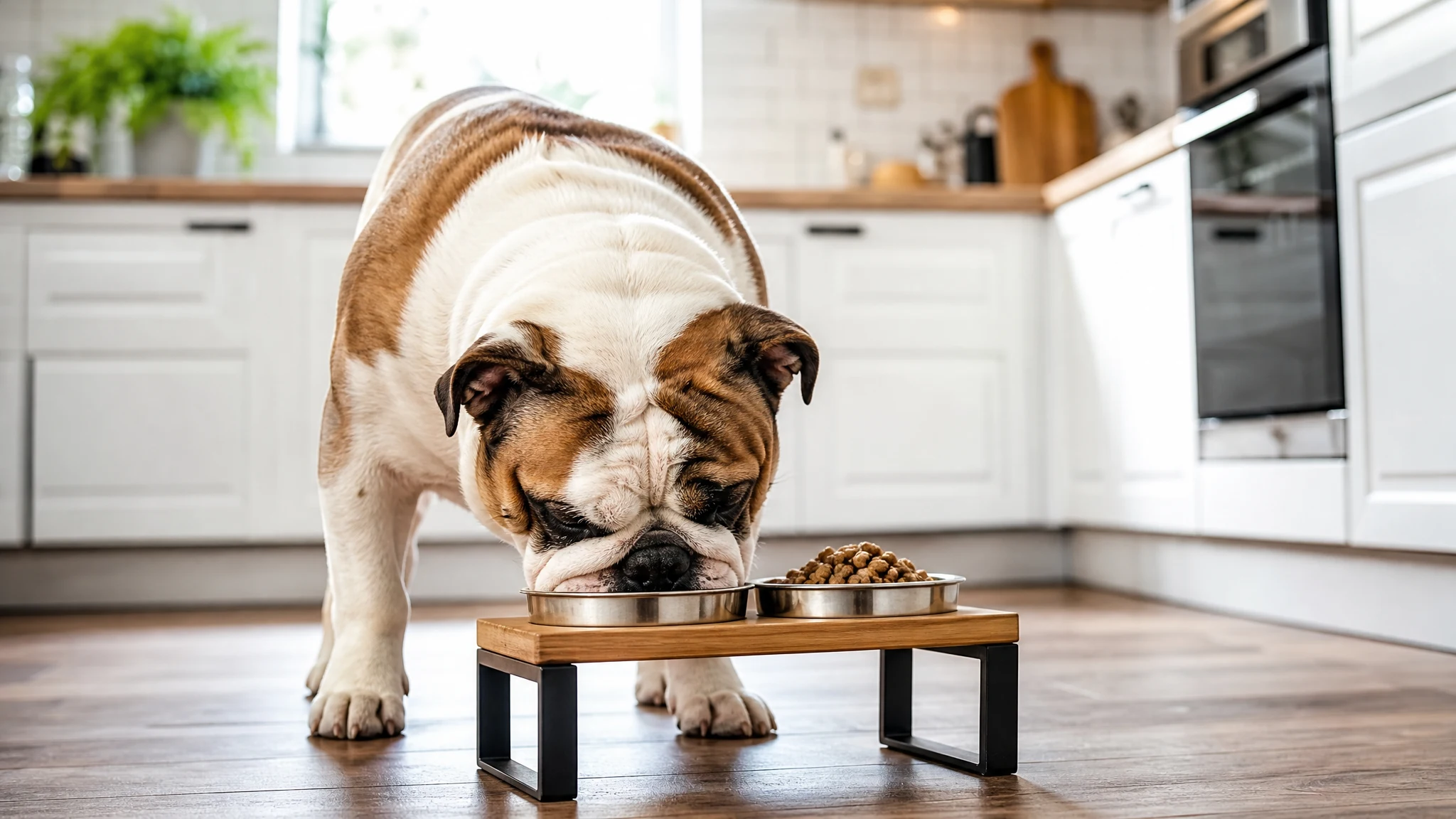
Measure every meal. Eyeballing a scoop is one of the easiest ways to overfeed. PetMD also says slow feeder bowls can slow down fast eaters.
Step 6: Count treats
PetMD advises that treats be no more than 10% of daily calories. Treats are an easy place to overspend and to overfeed. Pulling a few kibbles from the daily measure for training is a low-cost way to stay within that limit.
Step 7: Switch foods slowly and watch
When you change foods, mix the new food into the old over several days. Watch stools, appetite, skin and energy. Weigh your dog every few weeks and note body condition.
If you have a puppy, Royal Canin gives two ages for the move to an adult formula. Its Bulldog Adult page says 12 months and older. Its Bulldog Puppy page says to move to adult after 15 months. Ask your veterinarian which timing suits your dog.
Tips for saving without cutting corners
- Choose one complete and balanced food and stay with it, instead of rotating through costly trial bags.
- Buy a size you can finish while the food is fresh. Store it in a cool, dry place.
- Compare cost per day, not cost per bag.
- Keep your dog lean. Overfeeding wastes money, and PetMD notes that extra weight makes breathing trouble and joint problems worse.
- Check the brand's own site for feeding guides before you buy.
Common mistakes to avoid
- Comparing dry-matter and as-fed numbers. They are not on the same scale.
- Choosing by marketing. Phrases like "premium" or "natural" are not nutrition guarantees. Read the adequacy statement instead.
- Buying large-breed food by default. An adult English Bulldog is a medium breed, and the large-size rule starts at 70 lb.
- Assuming grain-free is better. FDA's investigation into a possible link between certain diets and canine dilated cardiomyopathy had its last public update on December 23, 2022. FDA says report counts alone do not establish a causal link. Ask your veterinarian if you are unsure.
- Using food to manage a condition on your own. PetMD says some dogs with allergies need a special diet. A veterinarian decides that for an individual dog, and prescription diets come only from a veterinarian.
- Feeding by the scoop that came with the bag. Measure with a real cup or scale.
What to expect
With a complete and balanced food, measured portions and regular weigh-ins, many owners find it easier to keep a Bulldog at a healthy weight. That may reduce strain on the breathing and joints, though results vary by dog.
No food can promise a specific outcome, and no food prevents or treats a disease. If your dog has itchy skin, breathing trouble, ongoing digestive upset or a weight problem, confirm the food and amounts with your veterinarian before changing anything.
PetMD lists a life expectancy of 8 to 10 years for the breed. Steady, measured feeding is one part of a long-term plan, alongside vet visits and skin fold care.
Sources
- Bulldog Club of America, AKC Bulldog Breed Standard
- PetMD, Bulldog breed page
- Whole Dog Journal, In the Fine Print: Nutritional Adequacy Statements
- FDA CVM, Investigation into Potential Link between Certain Diets and Canine Dilated Cardiomyopathy
- Royal Canin US, Bulldog Adult product page
- Royal Canin US, Bulldog Puppy product page
- Hill's Pet, Science Diet Adult Perfect Weight Large Breed
- Hill's Pet, Science Diet Adult Large Breed No Corn, Wheat, Soy