Best Training Treats for English Bulldogs (and How Many to Give)
General nutrition information compiled from product labels and published sources, not veterinary advice. Your veterinarian is the right person to choose a diet for your dog, especially one with a health condition.
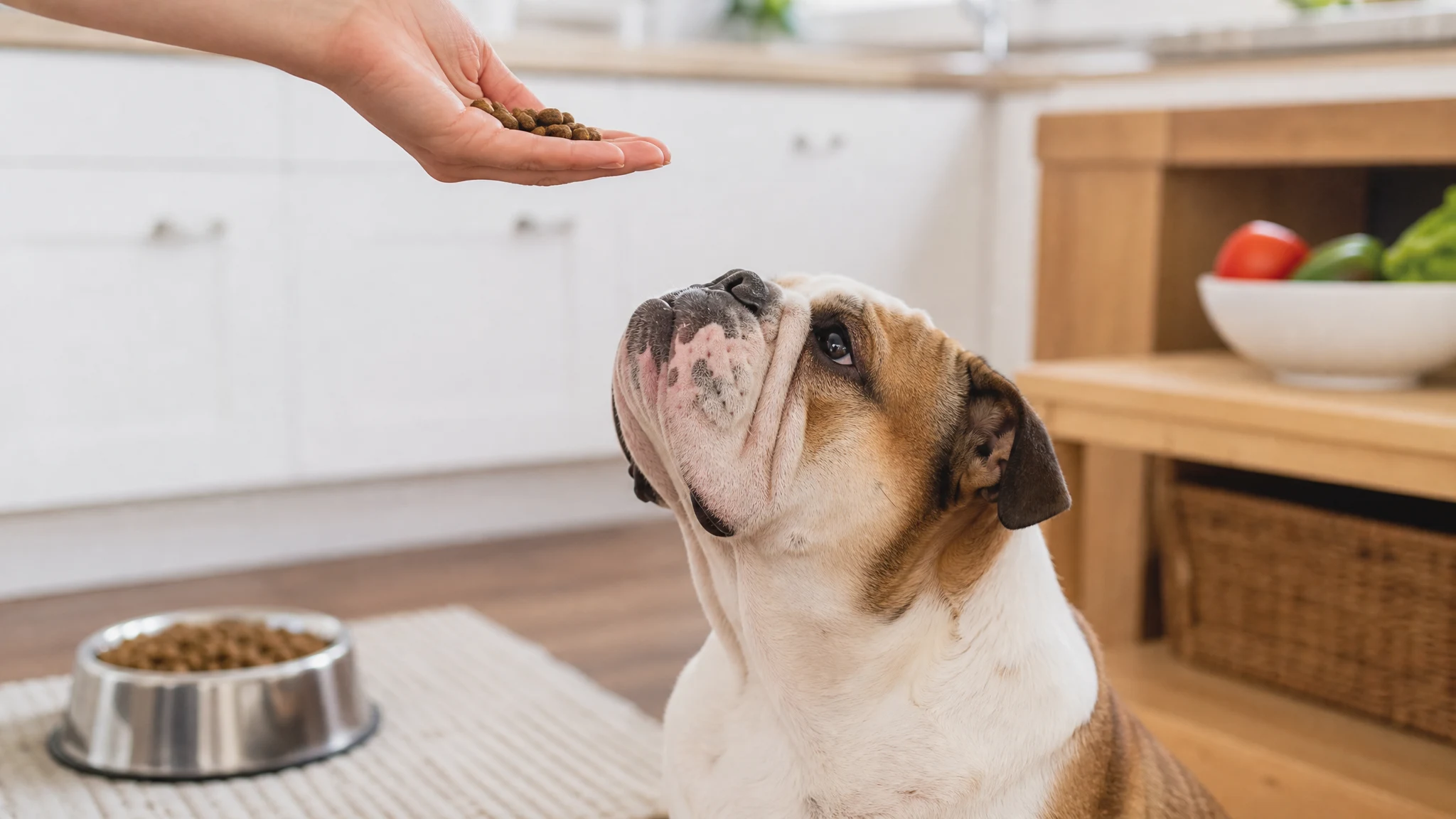
Training an English Bulldog usually means many short rewards. That is where the calories sneak in. A breed that PetMD describes as prone to obesity cannot afford a handful of treats at every session.
This guide is about choosing the best treats for English Bulldogs by type, cutting them to the right size, and working out how many fit into a day. It does not rank brands. No treat products are compared here, and we did not taste-test or feed anything ourselves.
Why treat math matters more for this breed
PetMD lists obesity as a common problem for the Bulldog, and notes that extra weight makes other conditions worse. Those include the breathing trouble linked to the flat-faced skull shape (brachycephalic obstructive airway syndrome) and hip dysplasia.
PetMD also advises basing portions on ideal weight and keeping treats to no more than 10 percent of daily calories. That limit is the backbone of everything below.
Treats do not cause or prevent any of these conditions on their own. A veterinarian decides what is right for an individual dog, including its target weight.
What you need
- Your dog's regular food and its feeding guide from the bag or the brand's website.
- A kitchen scale or measuring cup, to know what a day of food really is.
- Two or three treat types from different categories (see below), so the reward stays interesting.
- A treat pouch or small container, and a small knife or scissors for cutting treats down.
- The calorie number printed on each treat package. If a treat does not list calories, ask the brand before using it for training.
- A cool, quiet spot. Bulldogs overheat easily, so a short session in a comfortable room beats a long one outside.
The three treat categories worth knowing
Soft training treats
These are the usual choice for training because they are easy to break into tiny pieces and are quick to swallow. Read the label for the calorie count per treat and the first ingredients. Marketing words such as "natural" or "premium" do not tell you much. The ingredient list and the calorie statement do.
Freeze-dried single-protein treats
These contain one meat, such as chicken, and little else. The short ingredient list is easy to read, and the pieces crumble into small bits. They can be a handy option if your veterinarian has asked you to keep ingredients simple. They are not a cure for allergies. PetMD says some dogs with food allergies need a special diet, and that is a veterinary decision.
Vegetables
Small pieces of dog-safe vegetables can be a lower-calorie reward for a dog that loves food. Ask your veterinarian which vegetables suit your dog. Cut pieces small and soft enough to avoid choking. Some dogs ignore vegetables, so test one at home before relying on it in a distracting place.
Step by step: set up a treat plan
Step 1. Find your dog's daily food amount
Start with the feeding guide on your dog's food. Treat it as a starting point, not a rule. For example, the Royal Canin Bulldog Adult page lists 2 7/8 cups a day for a 40 lb dog at low activity, and states 277 kcal per cup as fed. That works out to roughly 800 kcal a day, which is our own arithmetic from those two label numbers.
Your dog's food, weight and activity will differ. Use your own label and ask your veterinarian about your dog's ideal weight.
Step 2. Work out the treat allowance
Take 10 percent of the daily calories. Using the example above, that is about 80 kcal for the whole day, all treats included. PetMD gives the 10 percent ceiling, and it is a maximum, not a target. Many Bulldogs do better on less.
Step 3. Divide the allowance into treat pieces
Read the kcal per treat on the package. If a soft treat is listed at 3 kcal, then 80 kcal is about 26 of them. If the package lists 10 kcal per treat, you only have about 8. Then cut each treat into smaller pieces, and the count rises.
The 3 and 10 kcal figures are examples to show the math, not values for any product.
Step 4. Cut treats to a tiny size
For a medium dog of about 40 to 50 lb (the Bulldog Club of America breed standard gives about 50 lb for males and about 40 lb for females), a training reward only needs to be a taste. Think pea-sized or smaller, and about the size of a fingernail for soft treats.
Tiny pieces get eaten fast, which keeps the session moving. They also let you reward 30 times without 30 full treats. Large, hard or crunchy pieces are slower to eat and may be awkward for a flat-faced dog. Break them up or pick another type.
Step 5. Reward right away, and keep sessions short
Mark the behavior you want with a word such as "yes," then hand over the treat within a second or two. Reward-based training is what the American Veterinary Society of Animal Behavior (AVSAB) supports. Do not use punishment, collar corrections or force.
Keep sessions to a few minutes. Stop sooner if your dog is panting heavily or seems uncomfortable.
Step 6. Take treats out of the meal bowl
On heavy training days, use part of your dog's regular kibble as the reward. Count it as treats and reduce the dinner portion to match. This is the simplest way to keep the day's calories steady.
You can also set aside the day's measured treat pieces in the morning. When the container is empty, treats are over. Reward with praise or play for the rest of the day.
Step 7. Track weight and adjust
Weigh your dog on the same scale every few weeks, or ask your veterinary clinic to do it. If weight creeps up, trim treats and meals together. Do not just cut the meal, since the dog still needs complete nutrition from its food.
Our label-by-label comparison of English Bulldog foods explains how to read calories per cup, which you need for this math.
Tips that make it easier
- Rotate categories. A dog that gets the same soft treat all week may lose interest. Save the most exciting item for harder skills or noisy places.
- Use a slow feeder or scatter for kibble rewards. PetMD notes slow feeder bowls can slow eating, which helps a dog that gulps.
- Keep treats separate from the folds. Crumbs and drool in facial folds can add to skin care work. PetMD says moisture trapped in folds encourages infection, so wipe and dry them as part of your routine.
- Tell everyone in the house. If one person trains and another hands out biscuits, the 10 percent limit disappears quickly.
- Check chews and dental items too. Anything edible with calories counts toward the daily total.
Common mistakes
- Treats sized for a big dog. A whole biscuit is often several rewards worth of calories for a 40 to 50 lb dog.
- Not counting treats. Small things add up. A dog that is already at a healthy weight can drift upward with a few extra bites a day.
- Picking by the front of the bag. Check the calories and ingredient list. A treat can be marketed as healthy and still be calorie dense.
- Adding a new treat during a food trial. If your veterinarian has asked you to follow a diet for skin or stomach problems, ask before giving anything outside it.
- Long sessions in warm rooms. Bulldogs can overheat and struggle to breathe, per PetMD, so keep training cool and brief.
- Relying on food for everything. Mix in praise, a toy tug or a short walk as rewards.
What to expect
With steady, small rewards, many Bulldogs learn simple cues such as sit and come in a few weeks. Results vary by dog, age and how often you practice. Stubborn spells are common and do not mean the plan is failing.
Counting treats may help you keep your dog's weight steady, which can make life easier for a breed with breathing and joint concerns. Nothing here treats or prevents a medical condition. Your veterinarian can tell you whether the plan suits your dog.
When to ask your veterinarian
- Before changing the diet of a dog with skin, stomach or weight concerns.
- If your dog gets itchy, develops loose stools or vomits after a new treat.
- If you are unsure what your dog's ideal weight or daily calorie need is.
- Before using treats from a brand that does not list calories. Contact the brand and ask.