Bulldog Diet and Weight Control: Why It Matters for This Breed
General nutrition information compiled from product labels and published sources, not veterinary advice. Your veterinarian is the right person to choose a diet for your dog, especially one with a health condition.
For most dogs, a few extra pounds are a minor worry. For an English Bulldog, they are a bigger deal. The breed's build, airway and joints all react to extra weight. That is why the bulldog diet deserves more attention than a quick scoop from the bag.
This guide walks through a simple routine: measure, record, adjust and review. It also shows how to read a food label for calories, which is where most weight problems start.
Why weight matters so much for an English Bulldog
The Bulldog Club of America breed standard describes a medium dog of about 50 lb for mature males and about 40 lb for mature females. PetMD gives a similar range of roughly 40 to 50 lb. That is not much room. A few pounds over is a large share of body weight.
PetMD lists several breed concerns where weight plays a part:
- Obesity. PetMD says the breed is prone to it, and that extra weight worsens other conditions.
- Breathing. The flat-faced anatomy can cause breathing difficulty and overheating. PetMD notes that excess weight makes brachycephalic obstructive airway syndrome (BOAS) symptoms worse.
- Hips. PetMD says extra weight aggravates hip dysplasia.
- Skin. Allergies can cause skin problems, and PetMD says some dogs need a special diet to manage them. Moisture trapped in skin folds is a separate issue, handled by cleaning and drying the folds.
Food does not prevent or treat any of these. What a lean body can do is avoid making them harder on your dog. Your veterinarian decides what is right for an individual dog.
What you need before you start
- A kitchen scale or a standard measuring cup (a scale is more accurate for kibble).
- The bag or can of your dog's current food, with the calorie statement and feeding guide.
- A notebook or phone note for a weekly weight and meal log.
- A way to weigh your dog. Many vet clinics let you stop in for a weigh-in. Ask yours.
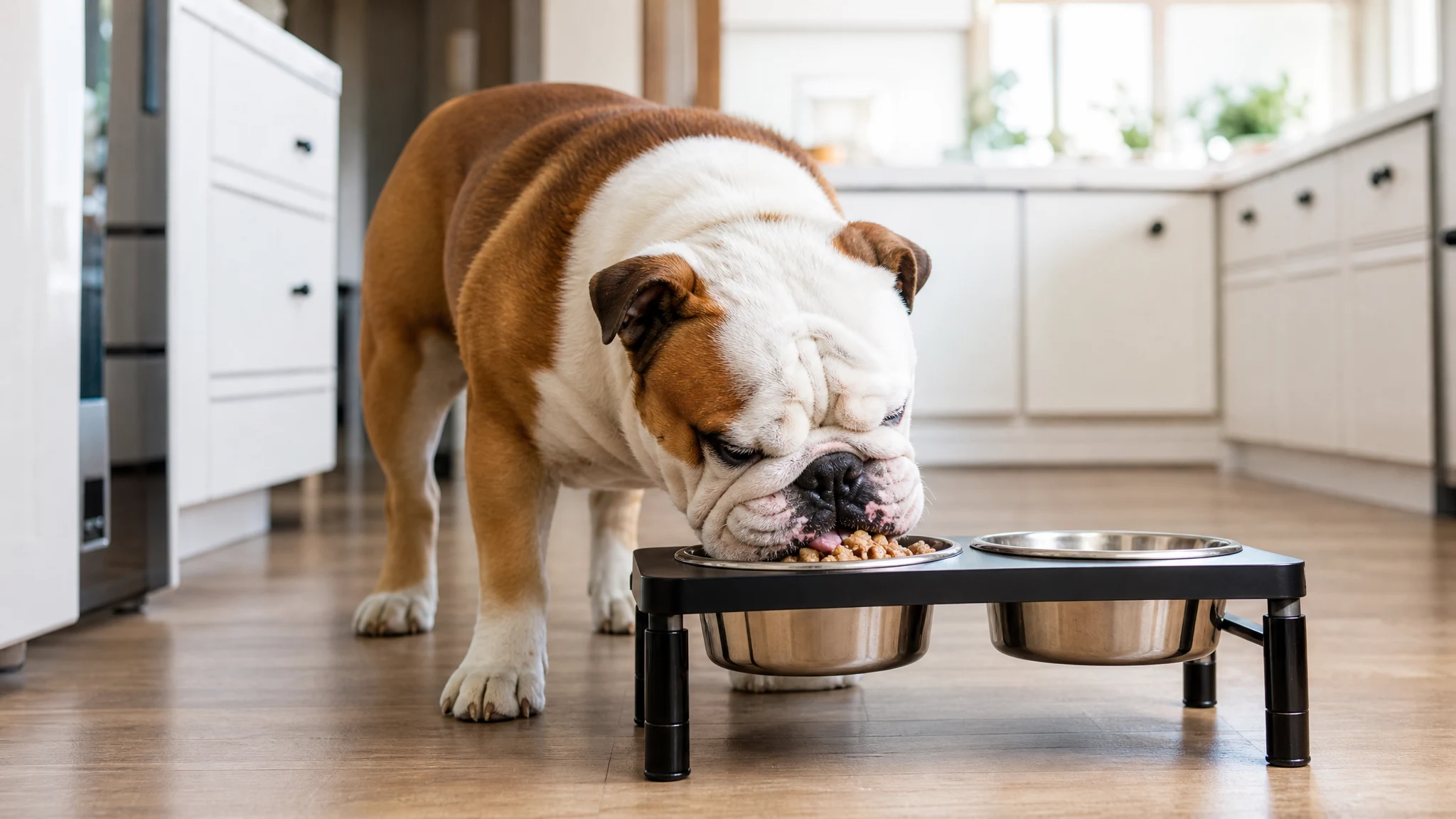
- A slow feeder bowl, if your dog gulps. PetMD says these can slow eating.
- A scheduled vet visit to set a target weight.
Step-by-step: building a bulldog diet around weight control
Step 1: Get a target weight from your vet
Ask your veterinarian what your dog's ideal weight is and how to judge body condition by sight and touch. PetMD advises basing portions on ideal weight, not on the weight your dog is today. A dog who is 10 lb over needs a plan for the weight he should be.
If your dog has a health condition, such as skin allergies, joint trouble or breathing problems, confirm every amount and food choice with your vet before changing anything.
Step 2: Read the calories on the label
Calories per cup vary a lot between foods. Two foods can look alike in the bowl and differ widely in energy. Here is what the manufacturers' own pages list:
| Food (brand page) | Form | Calories listed |
|---|---|---|
| Royal Canin Bulldog Adult | Dry | 277 kcal ME per cup, as fed (calculated) |
| Royal Canin Bulldog Puppy | Dry | 338 kcal ME per cup, as fed (calculated) |
| Hill's Science Diet Adult Perfect Weight Large Breed | Dry | 289 kcal per cup |
| Hill's Science Diet Adult Large Breed No Corn, Wheat, Soy | Dry | 390 kcal per cup |
We compared label data only. We did not run feeding trials or taste tests, so this is not a ranking. It simply shows why a cup of one food is not a cup of another.
A note on the Hill's foods: they are labelled for large-breed adults of 55 lb or more, which is above the usual English Bulldog weight. They are listed here for their calorie figures, not because they are made for Bulldogs. Ask your vet whether any food of this kind suits your dog.
Step 3: Start from the label's feeding guide
Treat the feeding guide as a starting point, not a final answer. The Royal Canin Bulldog Adult page, for example, gives a daily table by weight and activity level. It lists a 40 lb dog at low activity at 2 7/8 cups (219 g) per day. Your dog's own activity, age and body condition may call for something different, so check the guide for the food you actually use.
Hill's tells owners to adjust amounts as necessary to maintain optimal weight and to ask a veterinarian if unsure. That advice applies to any food.
For a breakdown by age, see our English Bulldog feeding chart by age.
Step 4: Measure every meal
Scoop-and-pour is where extra calories sneak in. A heaped cup can hold noticeably more than a level one. Weigh the portion or level it off each time.
PetMD suggests feeding adult Bulldogs twice a day. Split the daily total into two measured meals. A slow feeder bowl can help a fast eater.
Step 5: Count treats as part of the day's food
PetMD advises that treats be no more than 10% of daily calories. That includes training rewards, chews and table scraps. If treats are part of your routine, take that amount out of the meals, or use a few pieces of the dog's regular kibble as rewards.
Step 6: Weigh and log on a schedule
Weigh your dog on the same scale, at the same time of day, every week or two. Write the number down next to the daily food amount. Small trends show up in a log long before they show on the dog.
Step 7: Adjust slowly and review with your vet
If the weight is creeping up, trim the portion a little and recheck in a couple of weeks. Do not make big cuts or switch foods quickly on your own. Share your log with your vet at each visit and let them guide any change, especially for a puppy or a dog with a medical condition.
Choosing a life-stage food
Life stage matters for the label. Royal Canin's Bulldog Adult page says the formula is for Bulldogs 12 months and older. Its Bulldog Puppy page says to move to adult food after 15 months. These two ages differ, and both are manufacturer guidance, not veterinary guidance. Ask your vet when to switch your own puppy.
Check the nutritional adequacy statement on any food. The AAFCO statement should say whether the food is for maintenance, growth or all life stages. The large-breed growth qualifier (dogs of 70 lb or more as adults) does not apply to adult English Bulldogs at 40 to 50 lb, according to the breed standard. The Whole Dog Journal explains that smaller-breed puppies can eat foods labelled either way.
Some owners ask about grain-free diets. The FDA's investigation into a possible link between certain diets and canine dilated cardiomyopathy (DCM) last updated on December 23, 2022. The FDA says report counts alone do not establish a cause. If you are unsure about a food's ingredients, ask your vet.
Common mistakes to avoid
- Feeding by the bag's top number. Guides are written for an average dog. Use your dog's ideal weight and activity level.
- Forgetting treats. Many extra calories come from small bites that nobody counted.
- Free feeding. A bowl that is always full makes portion control impossible.
- Switching foods without checking calories. A new food with more calories per cup can add weight even at the same scoop size.
- Assuming a breed-named food is low calorie. A Bulldog formula is not automatically a weight-loss food. Read the label.
- Using a wet food made for another breed as if it were an English Bulldog formula. Royal Canin's French Bulldog loaf is made for French Bulldogs, and its calories are listed per 3 oz can, not per cup.
- Cutting food hard to lose weight fast. Gradual change, supervised by a vet, is safer.
What results to expect
Measured meals, counted treats and regular weigh-ins may help your dog reach and hold a healthier weight over time. A leaner English Bulldog may find breathing and moving around easier, and may be less likely to strain joints that are already prone to trouble. How fast this happens depends on the dog, so results vary.
Weight control is not a cure for any condition. Keep up routine skin-fold care and vet checkups alongside the diet.
Quick checklist
- Get an ideal weight from your vet.
- Check calories per cup on the label.
- Start from the label guide and measure each meal.
- Feed adults twice a day.
- Keep treats to 10% of daily calories or less.
- Weigh and log regularly.
- Adjust slowly with your vet.
Sources
- PetMD, Bulldog breed page
- Bulldog Club of America, AKC Bulldog Breed Standard
- Royal Canin US, Bulldog Adult
- Royal Canin US, Bulldog Puppy
- Royal Canin US, French Bulldog Loaf In Sauce
- Hill's Pet, Science Diet Adult Perfect Weight Large Breed
- Hill's Pet, Science Diet Adult Large Breed No Corn, Wheat, Soy
- Whole Dog Journal, In the Fine Print: Nutritional Adequacy Statements
- FDA CVM, Investigation into Potential Link between Certain Diets and Canine Dilated Cardiomyopathy