English Bulldog Feeding Chart: What Changes as They Age
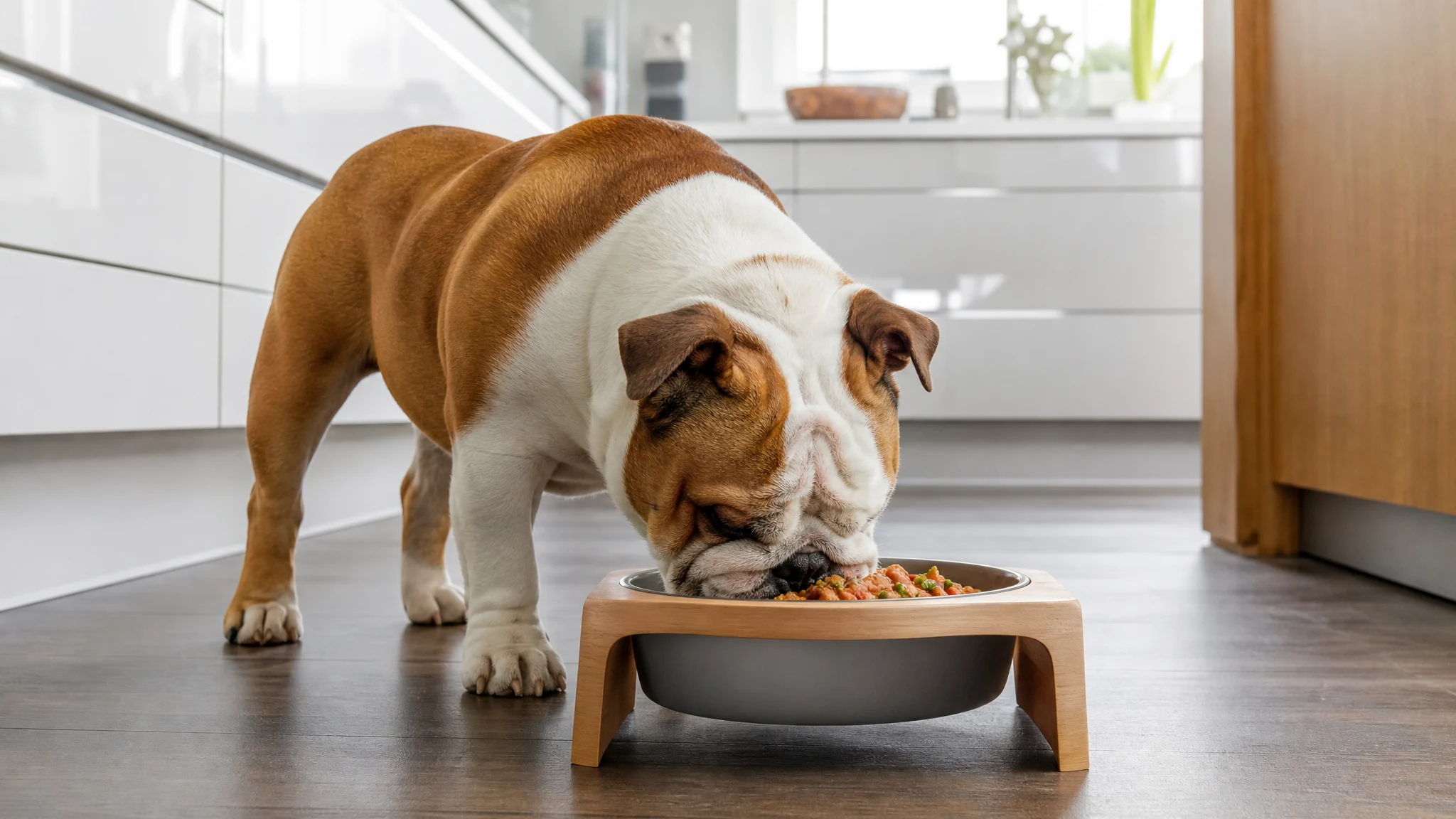
General nutrition information compiled from product labels and published sources, not veterinary advice. Your veterinarian is the right person to choose a diet for your dog, especially one with a health condition.
An English Bulldog feeding chart is a starting point, not a verdict. The right amount depends on your dog's ideal weight, age and activity, and those change over a lifetime. This guide shows how to build a simple chart for your own dog and how to adjust it at each stage.
For a ready-made table by age, see our companion page on the English Bulldog feeding chart by age.
How we compared the foods
We compared label data published by the brands: calories per cup, guaranteed analysis and the nutritional adequacy statement. We did not run feeding trials or taste tests. Label numbers describe a food on paper. They do not tell you how your Bulldog will do on it.
One more caution. Hill's publishes dry-matter averages rather than guaranteed minimums, so its protein and fat figures are not directly comparable to Royal Canin's as-fed guaranteed analysis.
What you need before you start
- Your dog's current weight and your veterinarian's opinion of their ideal weight.
- The bag or can of the food you plan to use, with its feeding guide and calorie statement.
- A standard 8 oz measuring cup, or a kitchen scale if the label lists grams.
- A notebook or phone note for weekly weights and body condition.
- A slow feeder bowl, if your dog gulps. PetMD notes these can slow eating.
Step 1: Know the breed's size and risks
The Bulldog Club of America's AKC breed standard describes a medium dog of about 50 lb for mature males and about 40 lb for mature females. PetMD gives roughly 40 to 50 lb and a life expectancy of 8 to 10 years.
PetMD also says the breed is prone to obesity, and that extra weight worsens breathing trouble from flat-faced anatomy (brachycephalic obstructive airway syndrome) and aggravates hip dysplasia. That is why a feeding chart for this breed focuses on staying lean. It is not a claim that any food prevents these conditions. A veterinarian decides what suits an individual dog.
Step 2: Pick the right life-stage food
Check the nutritional adequacy statement on the label. It should say the food is formulated to meet the AAFCO Dog Food Nutrient Profiles for growth, maintenance or all life stages.
Whole Dog Journal explains that foods labelled "including growth of large-size dogs (70 pounds or more as an adult)" suit large-breed puppies. An adult English Bulldog is well under 70 lb, so that rule does not apply to the breed. A puppy can eat a growth or all-life-stages food.
Royal Canin makes Bulldog-specific dry foods, so it is a useful brand to read for a stage-by-stage comparison. The label data below comes from the brand's own pages.
| Stage | Example food (label data) | Calories | Label protein / fat |
|---|---|---|---|
| Puppy, 8 weeks to about 15 months | Royal Canin Bulldog Puppy Dry | 338 kcal ME per cup, as fed | 28% min / 15% min |
| Adult, 12 months and older | Royal Canin Bulldog Adult Dry | 277 kcal ME per cup, as fed | 22% min / 12% min |
| Weight-conscious adult (size-adjacent) | Hill's Science Diet Adult Perfect Weight Large Breed | 289 kcal per cup | 28.8% / 11.2% (dry-matter averages) |
The Hill's food is labelled for large-breed adults of 55 lb or more, which is above an English Bulldog's usual weight. We list it because of its calorie level, not because it is made for Bulldogs. Ask your veterinarian before using a size-mismatched food.
The first five ingredients of Royal Canin Bulldog Adult are brewers rice, oat groats, chicken by-product meal, brown rice and wheat gluten. The puppy formula starts with chicken by-product meal, brewers rice, brown rice, chicken fat and wheat gluten. Read the whole panel yourself, especially if your dog has a known sensitivity.
Step 3: Start from the label's feeding guide
Every label has a daily feeding table. Treat it as a starting point for the whole day, not for each meal.
The Royal Canin Bulldog Adult table, for example, lists 2 7/8 cups (219 g) per day for a 40 lb dog at low activity. The Bulldog Puppy table works by puppy age and expected adult weight. Hill's directs owners to adjust amounts as necessary to maintain optimal weight and to ask a veterinarian if unsure.
Use your dog's ideal weight, not the current weight, when you read the table. PetMD gives the same advice: base portions on ideal weight.
Step 4: Set the meal schedule for the stage
- Puppies: The sources we relied on do not give a Bulldog-specific meal count for growing puppies. Ask your veterinarian how many meals to offer at each age.
- Adults: PetMD suggests feeding adults twice daily. Split the daily total into two equal meals.
- Seniors: The sources give no Bulldog-specific senior age or portion rule. Keep the twice-daily routine unless your veterinarian advises otherwise, and have your dog checked regularly.
Step 5: Handle the switch from puppy to adult food
The brand's own pages are not fully consistent here. Royal Canin's Bulldog Adult page describes the formula for Bulldogs 12 months and older. Its Bulldog Puppy page says to move to adult food after 15 months. That is manufacturer guidance, not veterinary advice.
Ask your veterinarian which date fits your dog. Then change over gradually, mixing a little more of the new food each day, and watch the stool and appetite.
Step 6: Count treats and extras
PetMD advises keeping treats to no more than 10% of daily calories. Take that amount out of the meal portion rather than adding it on top.
Fresh and wet foods change the arithmetic. Freshpet Home Cooked Chicken lists 189 kcal per cup. Royal Canin French Bulldog Loaf lists 70 kcal per 3 oz can, and that food is made for French Bulldogs, not English Bulldogs. Hill's Adult Chicken & Barley canned lists 369 kcal per 13 oz can. Always convert to calories, not scoops, before you swap or mix foods.
Step 7: Weigh, adjust and record
- Weigh your dog every week or two and write it down.
- Check that you can feel the ribs under a light covering and see a waist from above. Ask your veterinarian to show you what a healthy body condition looks like on a Bulldog.
- If weight creeps up, trim the portion slightly and recheck in a few weeks. Do not make big cuts without veterinary guidance.
- Update the chart after any change in weight, activity, health or food.
Tips
- Use a measuring cup every time. A scoop or coffee mug can be off by a lot.
- Keep one written chart where everyone in the house can see it, so the dog is not fed twice.
- Slow feeder bowls may help a fast eater. PetMD mentions them as an option.
- Keep your dog lean in warm weather, since PetMD links extra weight with worse breathing trouble and overheating.
- Cleaning and drying skin folds is a separate task from feeding. PetMD describes trapped moisture, not diet, as the issue with fold infections.
Common mistakes
- Feeding to the current weight of an overweight dog. Use the ideal weight.
- Forgetting treats. They add up quickly in a medium dog.
- Choosing by breed name alone. A Bulldog label does not replace reading the calories and ingredients.
- Picking a large-breed food by assumption. The English Bulldog is a medium breed, so the large-breed rules do not apply to it.
- Reading a dry-matter figure as a guaranteed minimum. Hill's lists averages, and the basis differs from other brands.
- Treating a health problem with a food change on your own. PetMD notes some dogs with skin allergies need a special diet. A veterinarian should decide that.
What to expect
With a measured portion, a regular schedule and routine weigh-ins, many owners find it easier to keep a Bulldog near a healthy weight. A lean dog may breathe and move more comfortably, though results vary by dog and no food or chart can promise an outcome.
If your dog has a health condition such as skin problems, joint disease or breathing trouble, confirm amounts and food type with your veterinarian before you change anything. We cannot say which food suits your dog, and prescription diets are something only a veterinarian prescribes.
On the heart question, the FDA said its last public update on the diet-related dilated cardiomyopathy (DCM) investigation was December 23, 2022. The agency also said report counts alone do not establish a causal link. If you are weighing a food for that reason, talk with your veterinarian.
For other label details, such as exact kibble size, check with the brand. The pages we read do not state them.
Sources
- Bulldog Club of America, AKC Bulldog Breed Standard
- PetMD, Bulldog breed page
- Whole Dog Journal, In the Fine Print: Nutritional Adequacy Statements
- FDA CVM, Investigation into Potential Link between Certain Diets and Canine Dilated Cardiomyopathy
- Royal Canin US, Bulldog Adult
- Royal Canin US, Bulldog Puppy
- Royal Canin US, French Bulldog Loaf in Sauce
- Hill's Pet, Science Diet Adult Perfect Weight Large Breed
- Hill's Pet, Science Diet Adult Chicken & Barley canned
- Freshpet, Fresh From the Kitchen Home Cooked Chicken Recipe