English Bulldog Puppy Feeding Guide: The First Year
General nutrition information compiled from product labels and published sources, not veterinary advice. Your veterinarian is the right person to choose a diet for your dog, especially one with a health condition.
Feeding an English Bulldog puppy is mostly about three things: a food labelled for growth, amounts you measure instead of guess, and a lean body as the puppy matures. This English Bulldog puppy feeding guide walks through those steps in order.
One note on method. We compared label data published by the brands and sources named below. We did not run feeding trials or taste tests, and nothing here replaces your veterinarian's advice for your own puppy.
What You Need Before You Start
- A puppy food whose label carries an AAFCO statement for growth (or all life stages).
- A measuring cup or a kitchen scale. Label amounts are given in cups or grams.
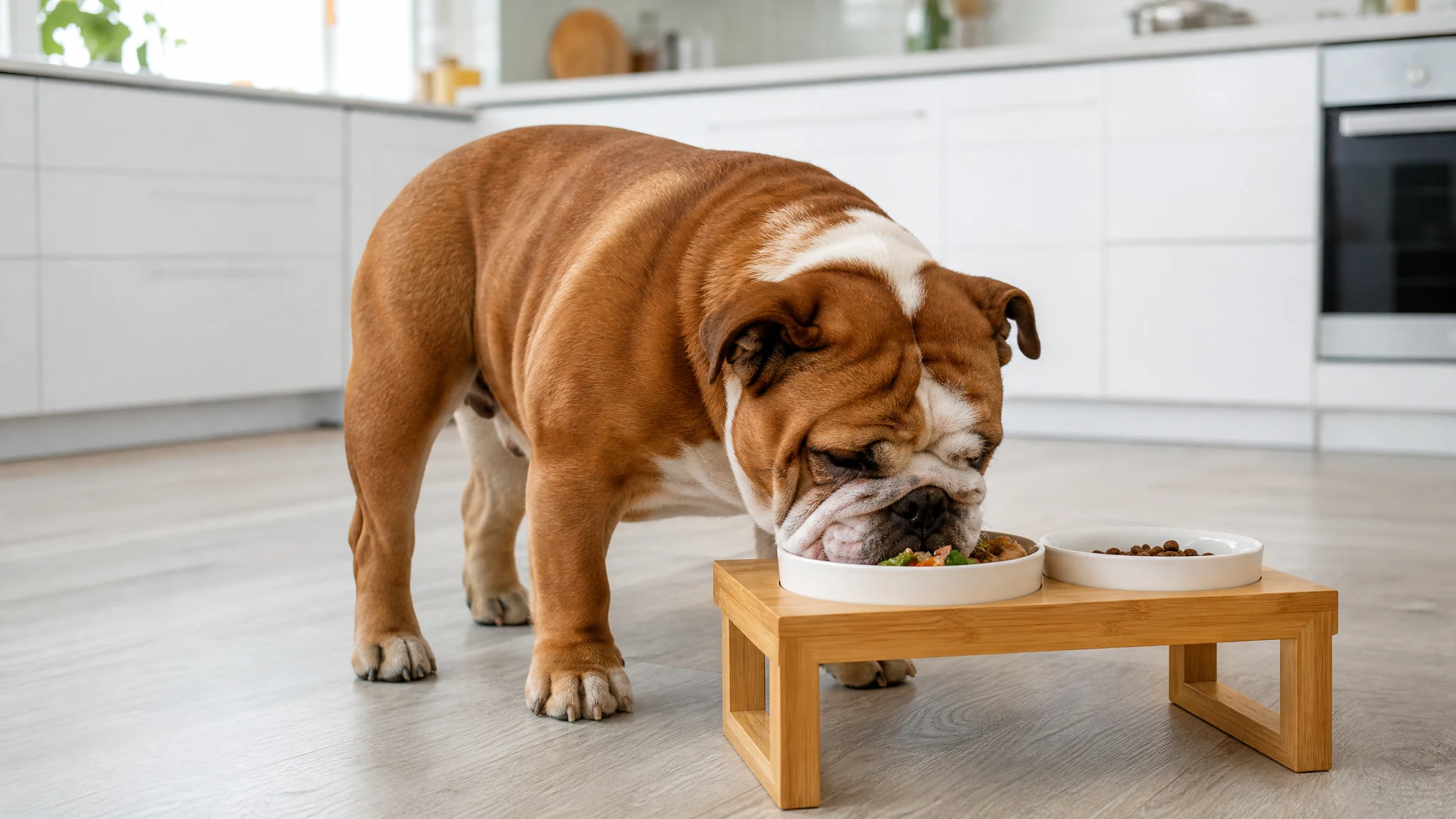
- A shallow bowl, or a slow feeder bowl. PetMD notes slow feeder bowls can slow eating in Bulldogs.
- The feeding table from the bag or the brand's page.
- A notebook or phone note for weights, meals and treats.
- Your veterinarian's contact details for weight checks.
Know the Breed You Are Feeding
The Bulldog Club of America's AKC breed standard puts mature dogs at about 50 lb and mature bitches at about 40 lb. That makes the English Bulldog a medium breed. PetMD gives roughly 40 to 50 lb.
PetMD also says the breed is prone to obesity, and that extra weight worsens other problems. Excess weight can make breathing symptoms of brachycephalic obstructive airway syndrome (BOAS) worse. It also aggravates hip dysplasia. Keeping a puppy lean is therefore a health goal from day one, not a cosmetic one.
Step-by-Step: Feeding Your Bulldog Puppy in the First Year
Step 1: Pick a food labelled for growth
Look for the nutritional adequacy statement, usually in small print near the ingredients. A puppy food should say it is formulated for growth or for all life stages under the AAFCO Dog Food Nutrient Profiles. An adult maintenance food is the wrong label for a puppy.
Check the large-size wording too. According to Whole Dog Journal, foods labelled for growth "including growth of large-size dogs (70 pounds or more as an adult)" suit large-breed puppies, and foods labelled "except for growth of large-size dogs" should not go to them. Smaller-breed puppies can eat either. An English Bulldog finishes at about 40 to 50 lb, so that large-size rule does not apply to the breed.
Step 2: Read the label, not the front of the bag
Marketing words such as "premium" or "natural" are not nutrition information. Use the statement, the ingredient list, the guaranteed analysis and the calories per cup.
As one example of label data, the Royal Canin Bulldog Puppy dry food page lists the following:
- For purebred Bulldogs 8 weeks to 15 months old.
- Statement: formulated to meet the nutritional levels established by the AAFCO Dog Food Nutrient Profiles for growth.
- First five ingredients: chicken by-product meal, brewers rice, brown rice, chicken fat, wheat gluten.
- Guaranteed analysis, as fed: protein 28% minimum, fat 15% minimum, fiber 4.0% maximum.
- Calories: 338 kcal ME per cup, calculated.
That is a description of the label, not an endorsement. Kibble size is not stated on the page, so ask the brand if size matters for your puppy.
Step 3: Compare foods on the same basis
Be careful when comparing numbers. Some brands print as-fed guaranteed minimums. Others print dry-matter averages, which are not the same thing.
| Puppy food | Protein | Fat | Fiber | Calories per cup | Basis |
|---|---|---|---|---|---|
| Royal Canin Bulldog Puppy | 28% min | 15% min | 4.0% max | 338 kcal | Guaranteed analysis, as fed |
| Hill's Science Diet Puppy Large Breed Chicken & Brown Rice | 26.7% | 15.4% | 2.8% | 387 kcal | Dry matter average |
The Hill's food is labelled for large-breed puppies that will be over 55 lb as adults, which is above a Bulldog's usual weight. It is listed here only as a size-adjacent label for comparison, not as a Bulldog formula. See the Hill's Pet product page for the full label.
Step 4: Start with the label amount, then adjust
The Royal Canin puppy page gives a daily feeding table by puppy age and target adult weight. Treat any table as a starting point. Your puppy's body condition and your veterinarian's weight checks decide whether to go up or down.
For a month-by-month view, see our English Bulldog feeding chart by age.
Step 5: Set a meal schedule
PetMD advises feeding adult Bulldogs twice daily. We did not find a published, breed-specific puppy meal count from the breed club or PetMD. Ask your veterinarian how many meals a day suit your puppy's age, and check the feeding guide on your chosen food.
Whatever the number, keep the times steady and split the daily amount across the meals instead of adding extras.
Step 6: Measure every meal
Use a measuring cup or scale at every meal. Level the cup instead of heaping it. Write the amount down for the first few weeks until it becomes routine.
Step 7: Count treats and training rewards
PetMD recommends treats make up no more than 10% of daily calories. Reward-based training uses plenty of small rewards, so use tiny pieces or pull a few kibbles from the day's measured meal.
Step 8: Check weight and body shape regularly
Ask your veterinarian to weigh the puppy at visits and tell you whether the body condition looks right. PetMD says portions should be based on ideal weight. A growing puppy changes quickly, so amounts that fit last month may not fit now.
Step 9: Plan the switch to adult food
Brand guidance varies. The Royal Canin Bulldog Adult page describes its formula for Bulldogs 12 months and older. The Bulldog Puppy page says to move to adult after 15 months. Both are manufacturer guidance, not a veterinary or breed club rule.
Ask your veterinarian when to switch. Change foods gradually over several days by mixing the new food into the old, and watch the stool and appetite.
Tips That Help
- Keep one food for a while before judging it. Frequent switching makes it hard to tell what is working.
- Feed in a calm spot. A slow feeder bowl may help a fast eater.
- Keep the puppy cool and rested around meals. Flat-faced breeds can overheat, according to PetMD.
- Wet food is an option. The Royal Canin French Bulldog loaf is made for another flat-faced breed, not for English Bulldogs, so ask the brand and your veterinarian before using it.
- Fresh foods such as Freshpet, Nom Nom or JustFoodForDogs publish their own statements and calories. Check each label for the life stage it covers.
Common Mistakes to Avoid
- Feeding by eye. A bulldog's wide frame and skin folds can hide extra weight.
- Using an adult maintenance food for a puppy. Check that the statement covers growth.
- Assuming large-breed means better. The English Bulldog is a medium breed, so a large-breed label is not automatically a match.
- Counting only meals. Chews, table scraps and training treats add calories.
- Adding supplements on your own. We give no supplement amounts. Ask your veterinarian before adding any.
- Treating food as a fix for a health problem. No food prevents or cures hip dysplasia, allergies or heart disease. PetMD says some dogs with allergies need a special diet, and a veterinarian decides that. Prescription diets come only from a veterinarian.
- Blaming skin-fold trouble on food. PetMD says fold infections come from trapped moisture, so clean and dry the folds.
A Note on Grain-Free and Heart Health
You may see grain-free foods discussed in connection with dilated cardiomyopathy (DCM). The FDA's last public update on its investigation was December 23, 2022. The FDA says it does not plan more public updates until there is meaningful new scientific information, and that report counts alone do not establish a causal link. If you are unsure, ask your veterinarian.
What to Expect
If you measure meals, count treats and keep up with weight checks, your puppy may grow at a steady pace and keep a lean, athletic shape. Results vary by puppy, and none are certain. Appetite, stool and energy can differ from dog to dog.
If your puppy has a health condition, such as skin problems, digestive trouble or breathing difficulty, confirm the food and the amounts with your veterinarian. Do not adjust them on your own.
Sources
- Bulldog Club of America, AKC Bulldog Breed Standard
- PetMD, Bulldog breed page
- Royal Canin US, Bulldog Puppy product page
- Royal Canin US, Bulldog Adult product page
- Hill's Pet, Science Diet Puppy Large Breed
- Whole Dog Journal, In the Fine Print: Nutritional Adequacy Statements
- FDA CVM, Investigation into Potential Link between Certain Diets and Canine Dilated Cardiomyopathy