English Bulldog Puppy Food: A Buying and Feeding Guide
General nutrition information compiled from product labels and published sources, not veterinary advice. Your veterinarian is the right person to choose a diet for your dog, especially one with a health condition.
Choosing english bulldog puppy food is mostly a label-reading job. Marketing pages promise a lot. The label, the nutritional adequacy statement and your puppy's body condition tell you more.
This guide walks through the steps in order. It also covers what to have on hand, mistakes to avoid and what results are realistic.
A note on method: we compared published label data from the brands named below. We did not run feeding trials or taste tests, and we are not rating products. Treat the examples as ways to practice reading labels.
What you need before you start
- The bag, can or product page for each food you are considering, with the full ingredient list and nutritional adequacy statement.
- Your puppy's current weight and your breeder's or shelter's notes on what the puppy has been eating.
- A kitchen scale or a standard measuring cup. Many brand feeding guides list cups or grams.
- A notebook or phone note to track portions, treats and weight checks.
- Your veterinarian's contact details. A vet decides what is right for an individual puppy.
Step 1: Know the breed you are feeding for
The Bulldog Club of America's breed standard describes the Bulldog (the AKC breed name for the English Bulldog) as a medium breed. Mature dogs are about 50 lb and mature bitches about 40 lb. PetMD gives a similar range of roughly 40 to 50 lb.
PetMD also notes that the breed is prone to obesity. Extra weight worsens breathing trouble linked to the flat face, and it aggravates joint conditions such as hip dysplasia. So the goal is steady, lean growth, not the fastest growth.
No food prevents or treats these conditions. Diet is one part of keeping a puppy lean, and your vet is the person to ask about any health concern.
Step 2: Find the nutritional adequacy statement
Look for a sentence that says the food is formulated to meet the AAFCO Dog Food Nutrient Profiles for a life stage. For a puppy you want wording for growth or for all life stages.
A food labelled for adult maintenance only is not a puppy food. For example, Hill's Science Diet adult recipes state they are not for puppies.
Some statements add a size qualifier. According to Whole Dog Journal, foods labelled for growth "including growth of large-size dogs (70 pounds or more as an adult)" suit large-breed puppies. Foods labelled "except for growth of large-size dogs" should not be fed to them. Smaller-breed puppies can eat either.
An adult English Bulldog is about 40 to 50 lb, so this rule does not apply to the breed. Either type of statement is fine on that point.
Step 3: Read the ingredients and analysis
Ingredients are listed by weight, so the first five tell you the base of the recipe. Compare these two puppy and all-stage examples from the brands' own pages:
| Food | First ingredients | Protein / fat / fiber | Energy |
|---|---|---|---|
| Royal Canin Bulldog Puppy (dry) | Chicken by-product meal, brewers rice, brown rice, chicken fat, wheat gluten | 28% min / 15% min / 4.0% max, as fed | 338 kcal per cup |
| Victor Hi-Pro Plus Large Breed Puppy (dry) | Chicken, chicken meal, brown rice, whole grain millet, whole grain sorghum | 30% min / 14% min / 6.0% max, as fed | 365 kcal per cup |
The numbers are guaranteed minimums and maximums, not exact contents. Calories matter as much as percentages, because two foods with similar protein can differ in energy per cup.
Royal Canin says its Bulldog Puppy formula is for purebred Bulldogs from 8 weeks to 15 months. Victor's page lists all life stages and names the food for large breed puppies. We could not confirm whether Victor's statement includes the large-size wording, so check the bag. Victor is aimed at larger dogs, and an English Bulldog is a medium breed, so ask your vet whether it fits.
Hill's Science Diet publishes dry-matter averages rather than guaranteed minimums. Its Puppy Large Breed recipe is for puppies expected to be over 55 lb as adults, which is above the English Bulldog's usual weight. Do not compare its percentages directly with as-fed figures from other brands.
Step 4: Choose a format
Dry food is the easiest to measure. Fresh food is another option. Freshpet, Nom Nom and JustFoodForDogs all publish all-life-stages or adult statements for some recipes. Nom Nom's Chicken Cuisine states it covers growth of large-size dogs, and its page lists 244 kcal per cup.
Check each recipe's statement before assuming it suits a puppy. Freshpet's Home Cooked Chicken recipe, for example, is stated for adult maintenance.
Royal Canin lists a French Bulldog loaf in sauce as a flat-faced-breed wet food. It is a French Bulldog formula, not an English Bulldog one, and it is stated for adults.
Whatever format you pick, the rest of the steps are the same: confirm the statement, count the calories and watch the puppy.
Step 5: Start with the label's feeding guide
Every brand publishes a feeding table. Treat it as a starting point, not a target.
Royal Canin's Bulldog Puppy table is organized by puppy age and expected adult weight. Hill's says to adjust amounts as necessary to maintain optimal weight, and to ask your veterinarian if you are unsure. Freshpet's page lets you pick your dog's weight to view a daily amount.
PetMD advises basing portions on a dog's ideal weight, not its current weight if it is already heavy. For a growing puppy, our English Bulldog feeding chart by age explains how amounts change as a puppy grows.
PetMD says adult Bulldogs are fed twice daily. We did not find a published meal count for young puppies in our sources, so follow the brand's guide and ask your vet.
Step 6: Switch foods slowly and know when to move to adult food
When changing foods, mix a little of the new food into the old and shift the ratio over about a week. Slower is fine if the stool gets loose. Ask your vet if digestive upset lasts.
Royal Canin gives two ages for moving up. Its Bulldog Adult page describes the formula for Bulldogs 12 months and older. Its Bulldog Puppy page says to move to adult after 15 months. This is manufacturer guidance, not a veterinary or breed club rule. Your vet can help decide based on your puppy's condition.
Step 7: Check body condition every week or two
Weigh your puppy on the same scale and note it. Feel along the ribs. You should be able to feel them under a thin layer of padding without pressing hard.
If the puppy is gaining faster than the feeding guide predicts, or looks round, tell your vet before changing the food yourself.
Tips for feeding an English Bulldog puppy
- Count treats. PetMD recommends treats make up no more than 10% of daily calories. Use pieces of the regular kibble for training.
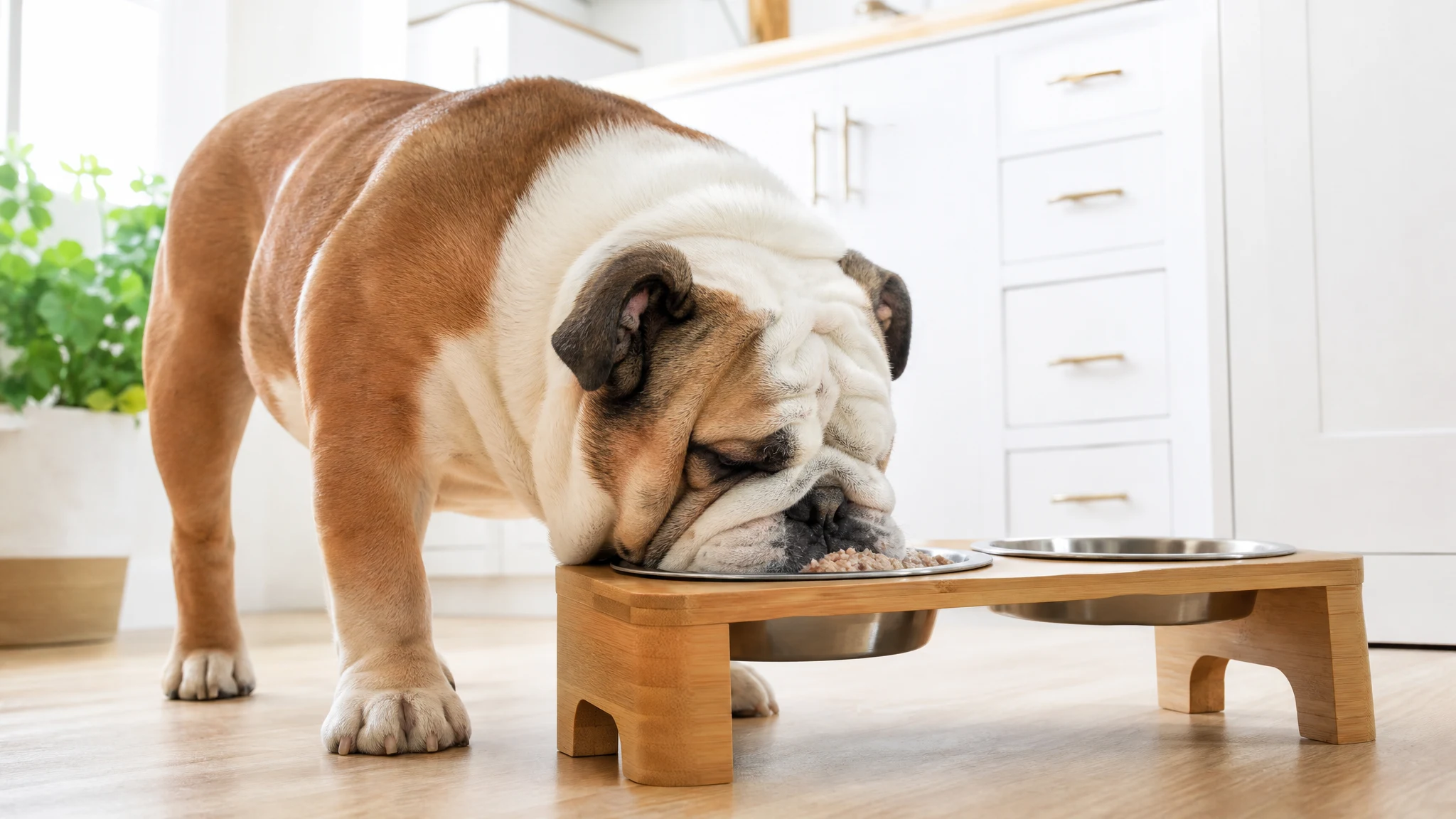
- Consider a slow feeder bowl. PetMD notes these can slow eating.
- Keep the facial folds clean and dry. PetMD says trapped moisture encourages skin fold infection. This is a hygiene issue, not a diet issue.
- Keep the same food while you evaluate it. Changing brands every few weeks makes it hard to tell what is working.
Common mistakes to avoid
- Buying by breed name alone. A Bulldog label tells you the target audience, not that the formula suits your puppy. Check the statement and calories.
- Choosing a large-breed puppy food because it sounds protective. The English Bulldog is a medium breed. Large-breed foods are sized for dogs over 55 or 70 lb, and no label shows they prevent joint problems.
- Comparing dry-matter and as-fed numbers. They are measured differently and cannot be set side by side.
- Feeding by the bag chart without adjusting. Activity, treats and metabolism differ between puppies.
- Using grain-free as a shortcut for quality. The FDA's investigation into diets and canine dilated cardiomyopathy had its last public update on December 23, 2022. The FDA says report counts alone do not establish a causal link. Ask your vet if you have concerns about a diet.
- Adding supplements on your own. Do not add any supplement without your vet's advice. Amounts for a puppy are a veterinary decision.
What results to expect
A well-matched food, measured carefully, may support steady growth, a healthy body condition and firm stools. Results vary between puppies, and no food can promise a particular outcome.
If your puppy has allergies, skin problems or another health condition, confirm amounts and food choice with your vet. PetMD notes that some dogs with allergies need a special diet. Prescription diets are only something a veterinarian prescribes.
For brand-specific questions, such as kibble size, which our sources did not state, check with the brand directly.
Quick checklist
- Confirm the statement says growth or all life stages.
- Compare calories per cup, not only protein.
- Start with the label's feeding guide and weigh regularly.
- Count treats toward the daily total.
- Ask your vet before changing foods for health reasons or moving to adult food.
Sources
- Bulldog Club of America, AKC Bulldog Breed Standard
- PetMD, Bulldog breed page
- Whole Dog Journal, In the Fine Print: Nutritional Adequacy Statements
- FDA Center for Veterinary Medicine, investigation into diets and canine dilated cardiomyopathy
- Royal Canin US, Bulldog Puppy product page
- Royal Canin US, Bulldog Adult product page
- Hill's Pet, Science Diet Puppy Large Breed
- Victor Pet Food, Hi-Pro Plus Large Breed Puppy
- Nom Nom, Chicken Cuisine