Feeding an English Bulldog by Age: A Step-by-Step Chart
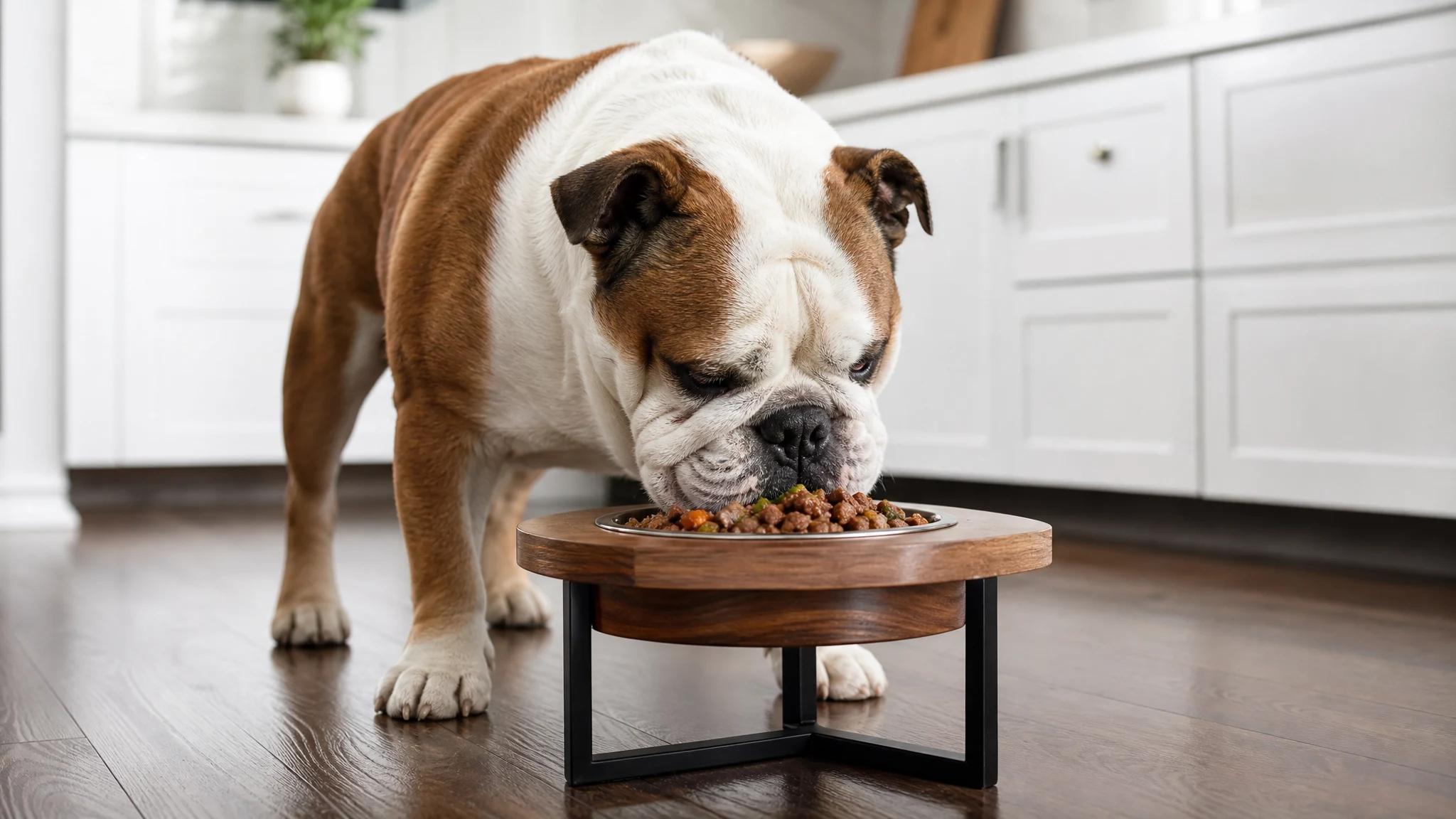
General nutrition information compiled from product labels and published sources, not veterinary advice. Your veterinarian is the right person to choose a diet for your dog, especially one with a health condition.
English Bulldogs are medium dogs, and the Bulldog Club of America breed standard describes mature dogs at about 50 lb and mature bitches at about 40 lb. That is a small body to feed, and it gains weight easily. PetMD lists obesity as a breed concern and says extra weight makes breathing trouble and joint problems worse.
This guide walks through an english bulldog feeding chart by age, one stage at a time. We compared label data from brand pages. We did not run feeding trials or taste tests, so treat every number as a starting point, not a prescription.
What you need before you start
- A complete and balanced food for your dog's life stage. Look for the AAFCO statement on the bag (growth, maintenance or all life stages).
- A standard measuring cup or a kitchen scale. Scooping by eye is a common way to overfeed.
- A bathroom or pet scale to track your dog's weight.
- A notebook or phone note for weights, portions and treats.
- Optional: a slow feeder bowl. PetMD says these can slow down fast eaters.
- Your veterinarian's phone number, for the check-ins described below.
The english bulldog feeding chart by age at a glance
The chart below gives the general pattern. Exact portions come from the label of the food you choose, and your vet adjusts them for your individual dog.
| Stage | Typical timing | Food type | How to set the amount |
|---|---|---|---|
| Puppy | 8 weeks to about 15 months (Royal Canin Bulldog Puppy range) | Growth or all life stages statement | Label feeding table by age and expected adult weight; confirm with your vet |
| Transition | About 12 to 15 months (Royal Canin gives both ages) | Adult maintenance formula | Switch gradually; ask your vet when |
| Adult | After the transition | Maintenance or all life stages statement | Label table by weight and activity; base on ideal weight; twice daily (PetMD) |
| Senior | Varies by dog; PetMD gives a life expectancy of 8 to 10 years | Ask your vet | Weight and body condition checks guide changes |
For a deeper look at portions, see our guide on how much to feed an English Bulldog at each age.
Step 1: Feed puppy food from 8 weeks
Royal Canin describes its Bulldog Puppy formula for purebred Bulldogs from 8 weeks to 15 months. Its label says the food is formulated to meet the AAFCO Dog Food Nutrient Profiles for growth. The guaranteed analysis lists 28% minimum protein and 15% minimum fat as fed, at 338 kcal ME per cup.
Royal Canin's feeding table runs by puppy age and target adult weight. Start there, then ask your vet how many meals a day suit your puppy. We could not find a source with a verified puppy meal schedule for the breed, so we will not guess one.
One label detail worth knowing: AAFCO's large-breed growth wording applies to dogs expected to reach 70 lb or more as adults, according to Whole Dog Journal. English Bulldogs are well under that, so a food labelled for large-size puppies is not required for them. Check the statement on any puppy food you consider.
Step 2: Weigh and measure every meal
Level the cup, or better, weigh the portion. A small error each day adds up in a dog that gains easily. PetMD advises basing portions on your dog's ideal weight, not the weight on the scale today.
Write down the amount. If your dog is overweight, your vet can tell you what ideal weight to use.
Step 3: Plan the move to adult food
Brands disagree on timing. The Royal Canin Bulldog Adult page says its adult formula is for Bulldogs 12 months and older. The Royal Canin Bulldog Puppy page says to move to adult after 15 months. These are manufacturer guidelines, not a veterinary rule.
Ask your vet which age fits your dog, based on growth and body condition. When you switch, mix the new food into the old over several days so the stomach can adjust. Your vet or the brand can suggest a schedule.
Step 4: Set the adult amount and schedule
PetMD recommends feeding adult Bulldogs twice daily. Split the day's total into two measured meals.
For the total, use the feeding table on the bag or brand page. As an example, Royal Canin's Bulldog Adult table lists 2 7/8 cups (219 g) per day for a 40 lb dog at low activity. The food is 277 kcal ME per cup as fed, with 22% minimum protein, 12% minimum fat and 4.1% maximum fiber. Your dog may need more or less, because activity, age and metabolism differ.
The Hill's Science Diet pages say much the same thing in their own words: adjust amounts as necessary to maintain optimal weight, and ask your veterinarian if unsure.
Step 5: Count the treats
PetMD says treats should be no more than 10% of daily calories. Many small training treats can add up fast. If treats go up, trim the meal portion to match.
Step 6: Check weight and body condition monthly
Weigh your dog at the same time each month and log it. Ask your vet to show you how to feel for ribs and a waist on a stocky, wrinkled dog, since a thick coat and loose skin can hide extra weight. If the trend moves up or down, adjust the portion in small steps and tell your vet.
Step 7: Revisit the plan as your dog ages
We did not find a verified age at which Bulldogs should move to senior food, so ask your vet. Some brands sell senior formulas, and some of those carry an all life stages statement on the label, which shows that the marketing name and the AAFCO statement are different things. Read the statement itself.
Choosing a food: what the labels show
Here is how a few options compare on label data only. We have not tested any of them.
- Royal Canin Bulldog Adult: first five ingredients are brewers rice, oat groats, chicken by-product meal, brown rice and wheat gluten. It is not grain free.
- Royal Canin Bulldog Puppy: first five ingredients are chicken by-product meal, brewers rice, brown rice, chicken fat and wheat gluten.
- Royal Canin French Bulldog Loaf in Sauce (wet): this is a French Bulldog formula, not an English Bulldog one. It lists 70 kcal ME per 3 oz can, so measure by can, not by cup.
- Hill's Science Diet Large Breed foods: these are labelled for dogs of 55 lb or more as adults, above the usual English Bulldog weight. Hill's publishes dry matter averages, not guaranteed minimums, so do not compare them directly with as-fed numbers.
Brand pages are at Royal Canin Bulldog Adult, Royal Canin Bulldog Puppy and Hill's Science Diet Adult Perfect Weight Large Breed. Kibble size is not stated on these pages, so ask the brand if that matters for your dog.
Common mistakes to avoid
- Feeding to the bag's top number. Label guides are starting points. Adjust to your dog's body condition.
- Using today's weight when your dog is overweight. PetMD says to base portions on ideal weight.
- Switching foods overnight. Change gradually.
- Ignoring treats. Keep them under 10% of daily calories.
- Treating a marketing name as a nutrition guarantee. Read the AAFCO statement.
- Grabbing a large-breed food by default. The breed is medium, so choose by the life stage statement and your vet's advice.
- Adding supplements on your own. Ask your vet first. We do not give supplement amounts.
Dogs with health conditions
PetMD notes that Bulldogs can have breathing problems from their flat-faced anatomy, hip dysplasia, and allergies or skin problems, and that some dogs need a special diet to manage allergies. Food does not treat or cure these conditions. If your dog has one, confirm every amount and food choice with your veterinarian. Prescription diets are available only through a vet.
You may also read about diet and heart disease in dogs. The FDA's last public update on its investigation into diets and dilated cardiomyopathy was December 23, 2022, and the FDA says report counts alone do not establish a cause. Ask your vet if you have questions about your dog's food.
What to expect
Measured meals, controlled treats and regular weigh-ins may help your Bulldog stay closer to a healthy weight over time. Keeping weight in check may ease strain on the joints and breathing, according to PetMD's notes on the breed. Results vary by dog, and no feeding plan guarantees an outcome. Expect to adjust the plan a few times in the first year.
Sources
- Bulldog Club of America, AKC Bulldog Breed Standard
- PetMD, Bulldog breed page
- Royal Canin US, Bulldog Adult
- Royal Canin US, Bulldog Puppy
- Royal Canin US, French Bulldog Loaf In Sauce
- Hill's Pet, Science Diet Adult Perfect Weight Large Breed
- Whole Dog Journal, In the Fine Print: Nutritional Adequacy Statements
- FDA CVM, Investigation into Potential Link between Certain Diets and Canine Dilated Cardiomyopathy