How Much Should an English Bulldog Eat? A Feeding Guide by Weight
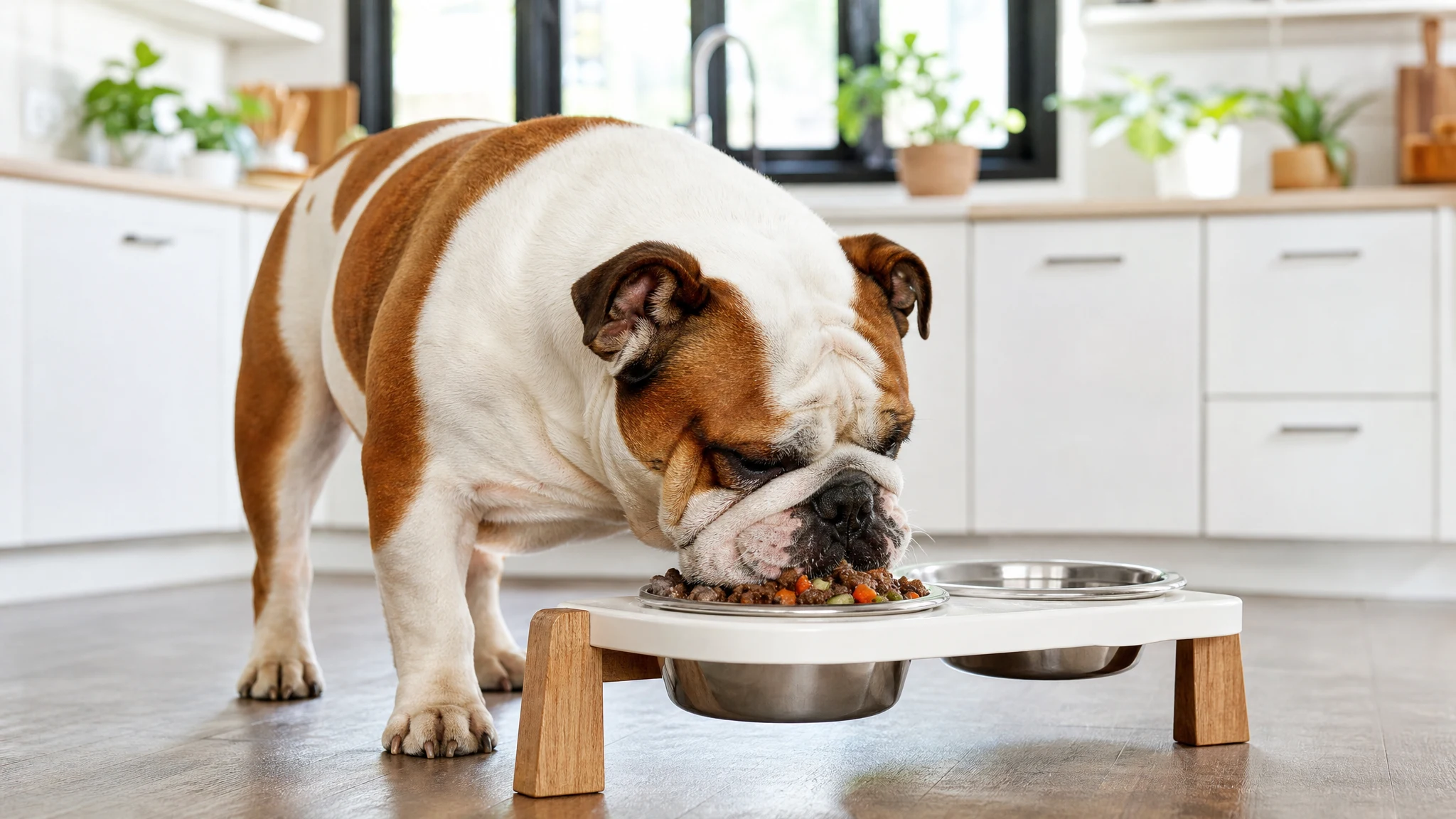
General nutrition information compiled from product labels and published sources, not veterinary advice. Your veterinarian is the right person to choose a diet for your dog, especially one with a health condition.
The honest answer to how much should an English Bulldog eat is that it depends on the food in the bowl. A cup of one food can carry far more calories than a cup of another. So the right amount starts with your dog's ideal weight, then the calories on your food's label, then your dog's age and activity.
This guide walks through that process in steps. The amounts here are label starting points, not prescriptions. We compared label data only. We did not run feeding trials or taste tests.
Why portions matter more for this breed
PetMD's Bulldog breed page says the breed is prone to obesity, and that extra weight worsens other conditions. It names brachycephalic obstructive airway syndrome (BOAS), where flat-faced anatomy causes breathing difficulty and overheating. PetMD says excess weight makes those symptoms worse, so keeping the dog lean matters. It also says extra weight aggravates hip dysplasia.
None of that means a food or a portion will prevent or treat a condition. It does mean that careful measuring is one of the few things an owner fully controls day to day.
Materials you will need
- A standard measuring cup, or better, a kitchen scale that reads in grams.
- The bag, can or tray your dog's food comes in, so you can read the label.
- A bathroom scale or your vet's scale to get a current weight.
- A notebook or phone note for weights, portions and treats.
- Optional: a slow feeder bowl. PetMD notes these can slow down eating.
Step 1: Know your dog's size and ideal weight
The Bulldog Club of America's copy of the AKC breed standard describes the English Bulldog as a medium breed. It gives about 50 lb for mature dogs and about 40 lb for mature bitches. PetMD gives roughly 40 to 50 lb. Those are breed ranges, not a target for your individual dog.
Your dog's ideal weight is the number that matters. Ask your veterinarian what it is, because a dog that is already overweight should be fed for the weight it should be, not the weight it is. PetMD advises basing portions on ideal weight.
Step 2: Read the calorie line, not just the cup guide
Find the calories per cup (or per can) on the label. Then compare it with the feeding table. Cups are a measure of volume, and foods differ a lot in how many calories fit in one.
| Food (label data) | Form | Calories listed |
|---|---|---|
| Royal Canin Bulldog Adult | Dry | 277 kcal ME per cup, as fed (calculated) |
| Royal Canin Bulldog Puppy | Dry | 338 kcal ME per cup, as fed (calculated) |
| Hill's Science Diet Adult Large Breed No Corn, Wheat, Soy Chicken & Brown Rice | Dry | 390 kcal per cup |
The Hill's food is labelled for large breed adults of 55 lb or more, which is above an English Bulldog's usual weight. It appears here only to show how much cup calories can vary. It is not made for Bulldogs.
One more label caution. Royal Canin lists guaranteed analysis as fed. Hill's publishes dry-matter averages for nutrients. Those numbers are not directly comparable, so do not rank foods by them without converting or asking the brand.
Step 3: Start from the brand's feeding guide
Use the on-pack or website table for your dog's weight and activity level. Treat the result as a starting point.
As one example, the Royal Canin Bulldog Adult page lists a 40 lb dog at low activity at 2 7/8 cups (219 g) per day. By simple multiplication with the listed 277 kcal per cup, that is a little under 800 kcal. That is our arithmetic, not a figure from the brand. Another food would give a different cup amount for the same dog.
Wet food works differently. The Hill's Science Diet Adult Chicken & Barley canned entree lists 369 kcal per 13 oz can, and its chart gives a 50 lb dog 3 1/4 cans per day. Always check the chart for your own food, because cans, pouches and fresh foods all use different units.
The English Bulldog feeding chart by age goes deeper on how amounts shift as your dog grows.
Step 4: Adjust for age and activity
Puppies. Puppy feeding tables are usually set by age and expected adult weight. The Royal Canin Bulldog Puppy page does this and covers puppies from 8 weeks to 15 months. We have no verified growth timeline for the breed, so ask your vet how to track your puppy's weight gain.
When to switch to adult food. Brand guidance differs. Royal Canin's Bulldog Adult page says the adult formula is for Bulldogs 12 months and older. Its Bulldog Puppy page says to move to adult after 15 months. That is manufacturer guidance, not veterinary advice, so ask your vet which timing fits your dog.
Activity. A calm dog that naps through the afternoon needs less than a dog that walks daily. Because of BOAS and overheating, many Bulldogs have limited exercise tolerance, so do not assume a high activity row on a chart applies to your dog.
Large-size puppy rule. Whole Dog Journal explains that AAFCO labels separate foods for growth of large-size dogs (70 lb or more as an adult) from foods that are not suitable for them. English Bulldogs are well under 70 lb as adults, so that distinction does not apply to this breed.
Step 5: Set a meal schedule
PetMD suggests feeding adults twice daily. Divide the day's total into two measured meals. Fresh-food brands such as Freshpet say on their pages that a daily amount can be fed as one meal or split in two. Splitting is the pattern PetMD recommends for the breed.
If your dog gulps, a slow feeder bowl may help slow the pace.
Step 6: Count treats and extras
PetMD says treats should be no more than 10% of daily calories. If you feed treats, trim the meals a little to make up for them. Chews, table scraps and toppers all count.
Step 7: Weigh, check and adjust
Weigh your dog every few weeks and write it down. Watch the body shape too, and ask your vet to show you how to judge a healthy waist and ribs. If your dog is gaining or losing, change the daily amount in small steps and recheck. Brand pages say much the same. Hill's, for example, tells owners to adjust amounts as necessary to maintain optimal weight and to ask a veterinarian if unsure.
Tips
- Weigh food in grams when you can. Scooped cups vary with how tightly the kibble packs.
- Change foods gradually, and ask your vet how to do it for your dog.
- Keep one person in charge of feeding, or use a shared note, so the dog is not fed twice.
- Check for a nutritional adequacy statement. Look for wording such as "formulated to meet the nutritional levels established by the AAFCO Dog Food Nutrient Profiles" and the life stage it names.
Common mistakes to avoid
- Feeding by the dog's current weight when it is overweight. Use the ideal weight.
- Using a cup guide from a different food. Calories per cup change from one food to the next.
- Assuming a "large breed" food suits a Bulldog. An English Bulldog is a medium breed, and large-breed labels are set for bigger dogs.
- Forgetting treats. They add up quickly in a small body.
- Treating a label as a medical plan. Skin trouble, a heavy weight, breathing problems or joint pain need a vet. PetMD notes some dogs need a special diet to manage allergies, and a veterinarian decides that for an individual dog. Prescription diets are only something a veterinarian prescribes.
If your Bulldog has a health condition, confirm any amount with your veterinarian before you change it. The same goes for supplements. Do not add them without asking your vet first.
What to expect
With measured meals and regular weigh-ins, many owners find it easier to keep a Bulldog at a lean, steady weight. That may make breathing and joints less strained, though results vary and no food or portion can promise a health outcome. The FDA's investigation into diet and canine dilated cardiomyopathy has had no public update since December 23, 2022, and the FDA says report counts alone do not establish a causal link. If you have questions about your dog's heart or diet, bring them to your vet.
For brand details, read the official pages directly, such as Royal Canin's Bulldog Adult page, and confirm current labels before you buy.
Sources
- Bulldog Club of America, AKC Bulldog Breed Standard
- PetMD, Bulldog breed page
- Royal Canin US, Bulldog Adult
- Royal Canin US, Bulldog Puppy
- Hill's Pet, Science Diet Adult Large Breed No Corn, Wheat, Soy
- Hill's Pet, Science Diet Adult Chicken & Barley canned
- Whole Dog Journal, In the Fine Print: Nutritional Adequacy Statements
- FDA CVM, Investigation into Potential Link between Certain Diets and Canine Dilated Cardiomyopathy