English Bulldog Nutrition: The Diet Factors That Matter for This Breed
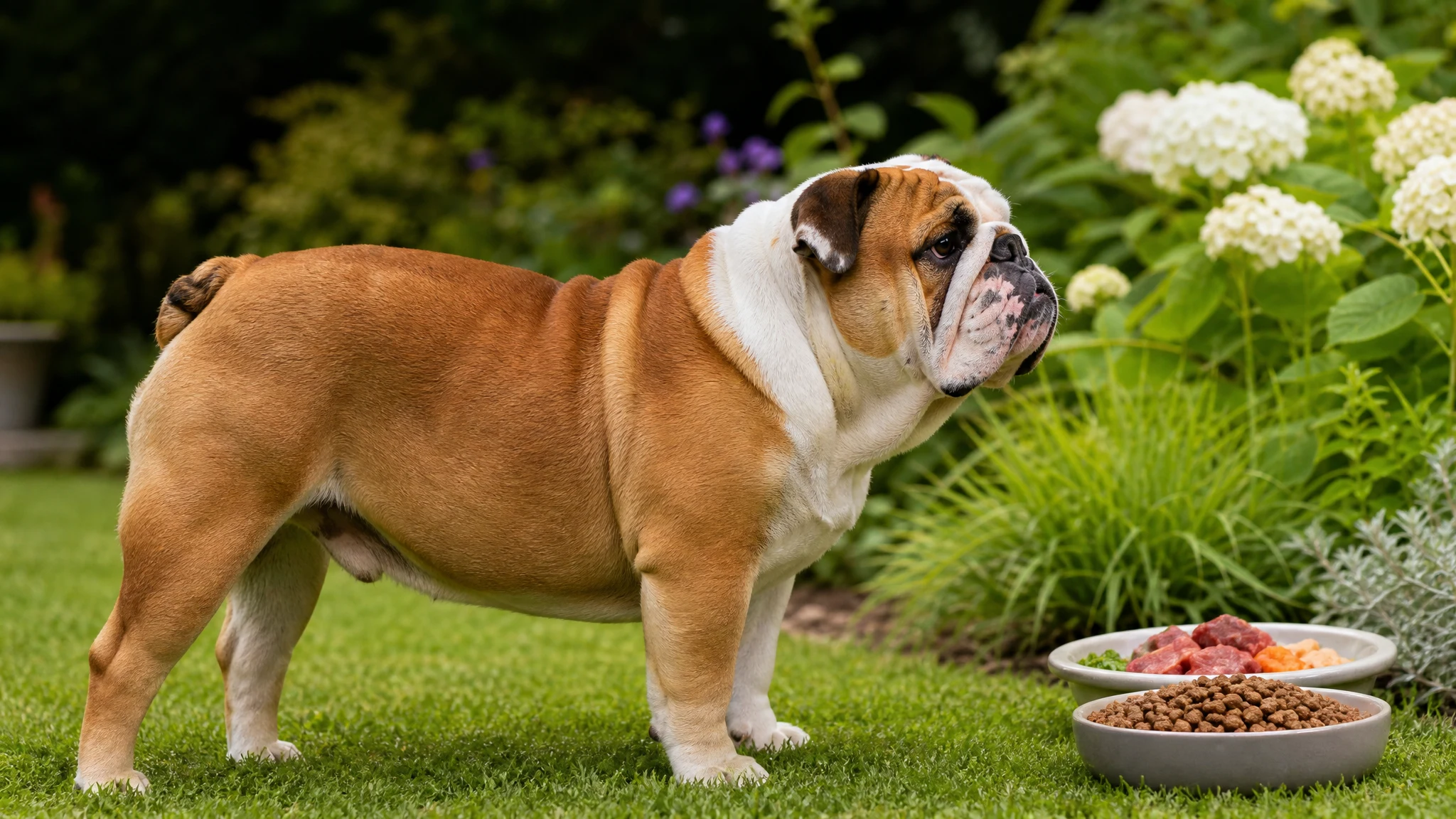
General nutrition information compiled from product labels and published sources, not veterinary advice. Your veterinarian is the right person to choose a diet for your dog, especially one with a health condition.
English Bulldog nutrition comes down to a few things that matter more for this breed than for most: staying lean, choosing the right life stage, watching calorie density, and knowing when a question belongs to your veterinarian. This guide turns those into steps you can follow at home.
It is not a ranking and it is not medical advice. It explains what the breed's health sources say about diet, and how to read a label with that in mind. A veterinarian decides what is right for an individual dog.
What you will need
- The bag or can your dog eats now, or the one you are considering. You need the full label, not just the front.
- A standard 8 oz measuring cup, or a kitchen scale if you prefer weighing portions.
- A recent weight for your dog, ideally from your veterinarian's scale.
- A notebook or phone note for daily food and treats.
- A slow feeder bowl, if your dog eats fast (optional).
- Your veterinarian's opinion on your dog's ideal weight.
First, the breed facts that shape the diet
The Bulldog Club of America, which publishes the AKC breed standard, lists the breed as medium in size. Mature dogs are about 50 lb and mature bitches about 40 lb. PetMD gives a similar range of roughly 40 to 50 lb, and a life expectancy of 8 to 10 years.
That size matters when you read labels. An English Bulldog is not a large breed, so large-breed adult formulas are sized for dogs heavier than yours.
PetMD's Bulldog page also flags several conditions that connect to food in one way or another. We cover each in the steps below. None of them can be prevented or treated by a food alone.
Step 1: Get an honest read on your dog's weight
PetMD describes the English Bulldog as prone to obesity, and says extra weight makes other problems worse. That makes weight the first diet factor, ahead of any brand or ingredient.
Ask your veterinarian for two things: a target weight and a body condition score. Write both down. Everything else, including portions, is based on the ideal weight and not the current one. PetMD says the same: base portions on ideal weight.
If you cannot feel your dog's ribs under a thin layer of padding, mention it at the next visit. Do not guess, and do not start a crash diet. Your veterinarian can set a safe pace.
Why weight carries so much weight in this breed
- Breathing. PetMD explains that the flat-faced anatomy can cause breathing difficulty and overheating, a condition called brachycephalic obstructive airway syndrome (BOAS). Excess weight makes the symptoms worse, so keeping the dog lean matters.
- Joints. PetMD says extra weight aggravates hip dysplasia. Food does not treat the condition, but a lighter dog puts less load on the joints.
Neither point says a particular food helps. They say body weight is the lever you control, and your veterinarian guides the rest.
Step 2: Match the life stage on the label
The nutritional adequacy statement is the fine print that says who the food is for. Look for words such as "maintenance," "growth," or "all life stages." Brands use the statement to say the food is formulated to meet the AAFCO Dog Food Nutrient Profiles for that stage.
Puppies
Whole Dog Journal explains the large-breed rule. Foods labelled for growth "including growth of large-size dogs (70 pounds or more as an adult)" suit large-breed puppies. Foods labelled "except for growth of large-size dogs" should not be fed to them. Smaller-breed puppies can eat either kind.
An adult English Bulldog is about 40 to 50 lb, so the 70 lb line does not apply to this breed. Still, read the statement so you know which kind of food you hold.
When to move to an adult food
Brand guidance varies. Royal Canin's Bulldog Adult page describes its formula for Bulldogs 12 months and older. Its Bulldog Puppy page says to move to adult after 15 months. Those are manufacturer figures, not veterinary or breed club rules. Ask your veterinarian when your own dog should switch, and make the change gradually over several days.
Adults and seniors
Adult maintenance foods suit most grown dogs. Some "all life stages" foods are higher in calories because they are built to support growth. For a breed prone to weight gain, that is worth noticing. Check the calories per cup before you pour.
Step 3: Read the calorie density, then set a starting portion
Calories per cup tell you more about weight control than the protein percentage does. Two bags can look alike and differ a lot per cup. Here is what the brand pages list for some foods you may see.
| Food (brand page) | Form | Calories listed |
|---|---|---|
| Royal Canin Bulldog Adult | Dry | 277 kcal ME per cup, as fed (calculated) |
| Royal Canin Bulldog Puppy | Dry | 338 kcal ME per cup, as fed (calculated) |
| Hill's Science Diet Adult Perfect Weight Large Breed | Dry | 289 kcal per cup |
| Hill's Science Diet Adult Large Breed | Dry | 390 kcal per cup |
| Freshpet Home Cooked Chicken Recipe | Fresh | 189 kcal per cup (calculated) |
The spread is wide. A cup of one dry food can carry well over a hundred more calories than a cup of another. Swapping foods cup for cup without checking can quietly add or remove a lot of energy.
Using the feeding guide as a starting point
Every feeding table on a bag is a starting point, not a prescription. As one example, Royal Canin's Bulldog Adult table lists 2 7/8 cups (219 g) per day for a 40 lb dog at low activity. Your dog's needs may differ, and the table is built for the label's own formula only.
- Find your dog's ideal weight on the chart, not the current weight.
- Pick the activity row that honestly matches your dog.
- Measure the daily amount and split it into two meals. PetMD suggests feeding adults twice daily.
- Reassess every few weeks with a weigh-in and adjust with your veterinarian.
Hill's makes the same point on its pages: adjust feeding amounts as necessary to maintain optimal weight, and ask your veterinarian if you are unsure.
Step 4: Read the ingredient list and analysis panel with the right expectations
Ingredients are listed by weight before cooking, so fresh meat can sit first on the list partly because it contains water. A meal or by-product further down may contribute a lot of dry protein. Neither is good or bad by itself. The list tells you what the food is made of, not how your dog will do on it.
Compare the panels with care. Brands do not always use the same basis:
- Many labels give a minimum for protein and fat and a maximum for fiber, as fed (with moisture included).
- Hill's pages publish dry-matter averages of nutrient content, which are not minimums or maximums. Do not put those numbers beside an as-fed panel and call one higher.
- Wet and fresh foods contain a lot of water, so their percentages look small. Compare them on a dry-matter basis or by calories.
Our comparison of foods by label lays out these differences product by product. We compared label data only. We did not run feeding trials or taste tests.
Step 5: Think about allergies and skin carefully
PetMD notes that environmental, food and flea allergies can cause skin problems in Bulldogs, and that some dogs need a special diet to manage them. That is as far as a general article can go.
If your dog itches, has recurrent ear trouble or sore skin, see your veterinarian first. Fleas and environmental triggers are common causes, and guessing at the food can waste months. If a diet change is the next step, your veterinarian will choose how to do it. Prescription diets are something only a veterinarian prescribes.
One related point: PetMD describes skin fold pyoderma, an infection that moisture trapped in facial and body folds encourages. It is handled by cleaning and drying the folds, not by food. A new bag will not fix a wet wrinkle.
Step 6: Treat the grain-free question as one for your veterinarian
You will see grain-free marketing. The FDA has investigated a possible link between certain diets and canine dilated cardiomyopathy (DCM). Its last public update on that page was December 23, 2022, and the FDA said it did not intend to release more public updates until there is meaningful new scientific information. It also notes that report counts alone do not establish a causal link.
So there is no clean rule to follow. If you are weighing a grain-free recipe against one with grains, ask your veterinarian about your dog's heart, history and needs. Nothing on a label can promise how a food affects a disease.
Step 7: Control treats and eating speed
PetMD advises keeping treats to no more than 10% of daily calories. In a breed that gains weight easily, that limit is useful. Count training treats, chews and table scraps. If treats go up, trim the meal slightly.
PetMD also mentions slow feeder bowls as a way to slow down fast eaters. A bowl is a small tool, not a medical fix, but it is cheap to try.
Step 8: Choose among food forms
Dry, wet and fresh foods can all carry a statement of nutritional adequacy. What differs is calories, water content and how easy portions are to measure.
- Dry. Easy to measure and store. Calories per cup vary, so check them.
- Wet. High in water. Royal Canin lists a French Bulldog loaf for a flat-faced breed, but it is a French Bulldog formula and not an English Bulldog one. Hill's lists an adult chicken and barley canned entree with a feeding chart by weight in 13 oz cans.
- Fresh. Freshpet, Nom Nom and JustFoodForDogs each publish their own AAFCO statements and feeding tools. Check each brand's page for the statement and the portion calculator.
Hill's "Large Breed" foods are labelled for dogs of 55 lb or more as adults. They are not made for Bulldogs. They appear in comparisons mainly because of their weight management angle. If you consider one, talk to your veterinarian about whether the size and calories suit your dog.
Whatever you choose, check the brand's own page for the current label. Formulas change.
Step 9: Switch foods slowly and track the result
- Mix a little of the new food into the old for several days, raising the share each day.
- Keep the daily calories steady while you switch.
- Note stool, appetite, itching and energy in your notebook.
- Weigh your dog every two to four weeks at first.
- Call your veterinarian if you see vomiting, ongoing loose stool, or breathing changes.
Common mistakes to avoid
- Feeding by the bag's front claims. Words like "natural" or "premium" are not nutritional measures. Read the statement and the panel.
- Using the current weight for portions. If your dog is overweight, use the ideal weight.
- Comparing percentages across different bases. Dry-matter and as-fed numbers are not interchangeable.
- Swapping foods cup for cup. Calories per cup can differ widely.
- Ignoring treats. They add up fast.
- Treating skin or breathing problems as a food issue only. Those need a veterinary exam.
- Assuming a large-breed formula is better. Your dog is a medium breed.
- Moving to adult food by the calendar alone. Brands disagree on timing, so ask your veterinarian.
Tips that help
- Keep a daily food log for two weeks. Patterns show up quickly.
- Measure with the same cup every time. Scoops vary.
- Use part of the daily kibble as training rewards, so treats do not stack on top.
- Keep walks short and cool in warm weather. Breathing difficulty in this breed is real, and overheating is a risk.
- Bring the label, or a photo of it, to every veterinary visit.
What results to expect
With steady portions and a lean target, many owners find their dog's weight becomes easier to hold steady over a few months. A lighter body may be easier on the joints and may make breathing and exercise more comfortable, though results vary from dog to dog and depend on many things besides food.
Do not expect a diet to clear up skin problems, protect the heart or cure a joint condition. Those belong to your veterinarian. What good nutrition can do is give your dog a sound base and make those conversations simpler.
Quick checklist
- Get an ideal weight from your veterinarian.
- Match the life stage statement to your dog's age.
- Compare calories per cup, not just protein.
- Use the feeding guide as a starting point, then adjust.
- Keep treats to no more than 10% of daily calories.
- Take skin, breathing and heart questions to your veterinarian.
- Switch foods gradually and weigh regularly.
Sources
- Bulldog Club of America, AKC Bulldog Breed Standard
- PetMD, Bulldog breed page
- FDA CVM, Investigation into Potential Link between Certain Diets and Canine Dilated Cardiomyopathy
- Whole Dog Journal, In the Fine Print: Nutritional Adequacy Statements
- Royal Canin US, Bulldog Adult
- Royal Canin US, Bulldog Puppy
- Hill's Pet, Science Diet Adult Perfect Weight Large Breed
- Hill's Pet, Science Diet Adult Large Breed