Grain-Free Food and English Bulldogs: What the FDA DCM Investigation Found
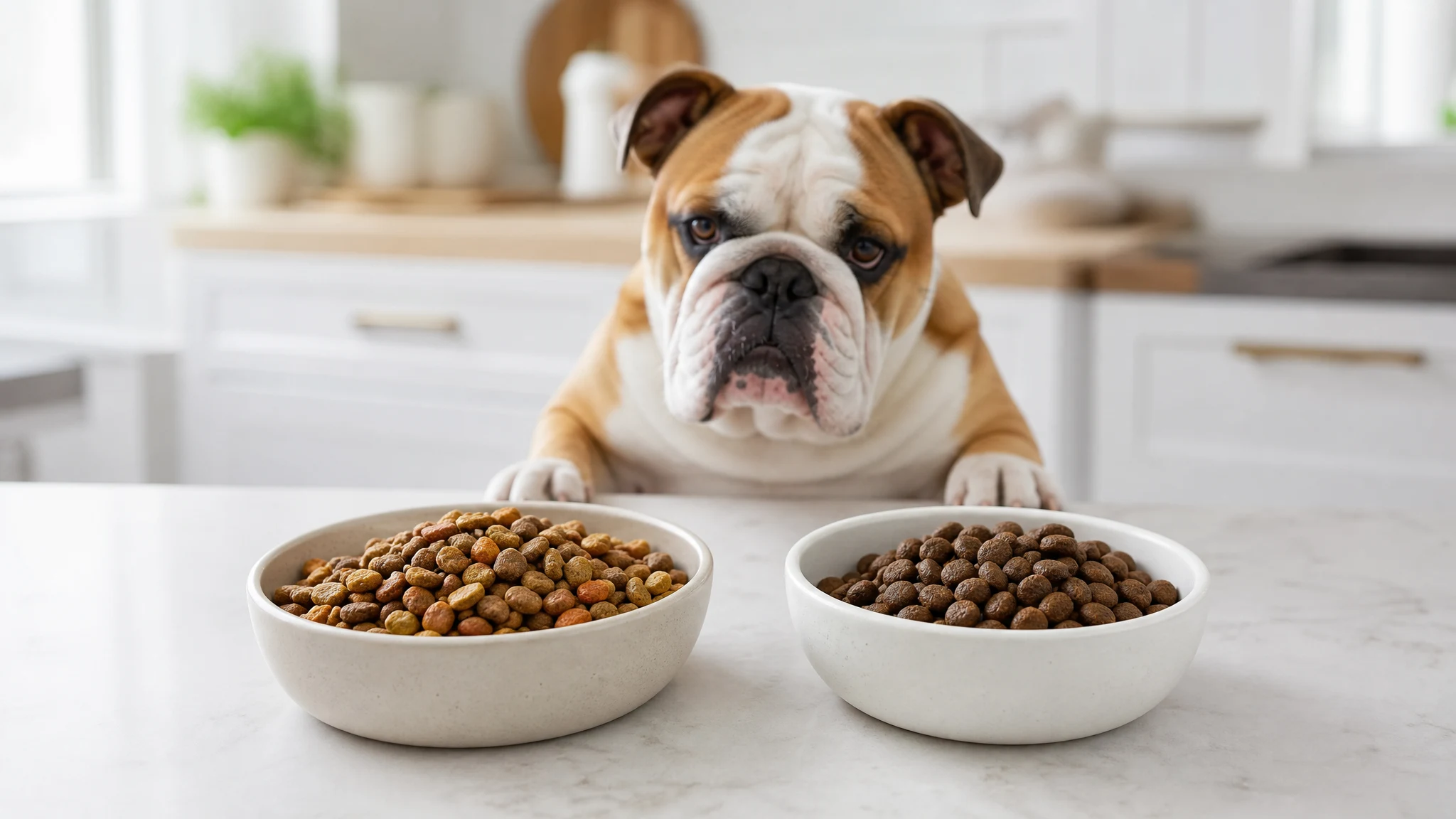
General nutrition information compiled from product labels and published sources, not veterinary advice. Your veterinarian is the right person to choose a diet for your dog, especially one with a health condition.
Grain-free dog food is sold as the cleaner, more natural choice. Then owners hear about a heart disease called dilated cardiomyopathy (DCM) and wonder if the bag in the pantry is a problem. English Bulldog owners often ask a sharper version of the question: is grain free bad for English Bulldogs?
This guide does not give a yes or no for every dog. It shows you how to read what the FDA published, how to read your own dog's food label, and how to prepare for a conversation with your veterinarian. The steps are about reviewing information, not changing a diet on your own.
What you need before you start
- The bag or can your Bulldog eats now, with the full ingredient list and the nutritional adequacy statement.
- The brand's own product page, if you can find it, for the same label data.
- The FDA page on the investigation into diets and canine DCM (linked in Sources below).
- A list of everything your dog eats, including treats, toppers and chews.
- Your dog's recent weight, and any notes about coughing, tiring easily or fainting.
- Your veterinarian's contact details, to book a diet discussion.
Step 1: Know what the FDA investigation is
The FDA's Center for Veterinary Medicine (CVM) opened an investigation into a potential link between certain diets and canine dilated cardiomyopathy. DCM is a disease of the heart muscle. The investigation looked at whether some diets might be connected to cases of the disease in dogs.
Many people shorthand this as the grain-free dog food DCM issue. That shorthand is looser than the FDA's own wording. The agency titled its page about a potential link between certain diets and DCM. It did not announce that grain-free food causes the disease.
Step 2: Read the latest status carefully
According to the FDA CVM page, the last public update on the investigation was December 23, 2022. The report count on that page was current as of November 1, 2022. The FDA also says it does not intend to release more public updates until there is meaningful new scientific information.
That means a few things for you:
- There is no newer FDA report count to compare against.
- Articles that quote fresh numbers are not coming from new FDA updates on that page.
- If you want to know whether anything has changed, check the FDA page itself rather than a summary.
Step 3: Separate what is known from what is not
Write two short lists. Here is how to fill them in using what the FDA says.
What the FDA page does say
- The agency investigated a potential link between certain diets and DCM in dogs.
- Its last public update was December 23, 2022.
- It does not plan more public updates until meaningful new scientific information appears.
- Report counts alone do not establish a causal link between a diet and DCM.
What the sources we reviewed do not tell you
- Whether your particular Bulldog's food is a risk. A report count cannot answer that.
- Whether grain-free as a category is the cause. The FDA says counts alone do not show causation.
- Any English Bulldog-specific DCM figure. We did not find one in the FDA page.
Keeping these lists separate protects you from two mistakes: panic and complacency. Some online posts treat the investigation as proof of harm. Others treat the missing updates as proof of safety. Neither reading is supported by the FDA's own wording.
Step 4: Check whether the breed has a stated DCM predisposition
This is the English Bulldog part of the question. The PetMD Bulldog breed page lists the conditions it associates with the breed. They include obesity, brachycephalic obstructive airway syndrome (BOAS), hip dysplasia, allergies and skin problems, and skin fold infections. DCM is not among the diet-relevant conditions we found there.
The Bulldog Club of America publishes the AKC breed standard. That document describes the dog's looks and build, not its disease risks. Neither source gives a stated DCM predisposition for the breed.
The honest reading is limited. Not finding a listing is not the same as proof that a breed has no risk. If heart health worries you, ask your veterinarian whether your dog warrants a heart check, and ask the breed club what it tracks. Do not treat the absence of a listing as clearance.
Step 5: Read your Bulldog's food label
Now turn to the bag. Work through these items in order.
- Find the adequacy statement. It should say the food is formulated to meet the AAFCO Dog Food Nutrient Profiles, or that feeding tests support it, for a stated life stage. Check that the stage matches your dog.
- Read the first five ingredients. Note whether grains appear. "Grain-free" is a marketing label, and an ingredient list is the way to confirm it. For example, Nom Nom's Chicken Cuisine lists chicken, sweet potatoes, squash, spinach and dicalcium phosphate first, with no grains in that list. That is our reading of the ingredient list, not a claim the brand makes.
- Look at the guaranteed analysis. Protein, fat and fiber are listed as minimums or maximums, as fed. Compare foods only on the same basis. Some brands, such as Hill's, publish dry-matter averages instead, which are not guaranteed minimums.
- Note the calories per cup. English Bulldogs are prone to obesity, according to PetMD, so energy density matters as much as the grain question.
- Check who the food is for. A formula for large-breed puppies is not automatically right for a 40 to 50 pound adult.
Our label-by-label comparison of foods for English Bulldogs follows this same checklist. We compared label data only. We did not run feeding trials or taste tests, and we cannot tell you how any food works in a given dog.
Step 6: Count the calories and the treats
Grain content is only one part of a Bulldog's diet. PetMD notes the breed is prone to obesity and that extra weight worsens other conditions. It also points out that excess weight makes breathing symptoms worse in flat-faced dogs and aggravates hip dysplasia.
Two habits from PetMD's feeding advice are worth copying:
- Base portions on your dog's ideal weight, not the current weight.
- Keep treats to no more than 10 percent of daily calories.
Feeding guides on the bag are starting points. For example, one Bulldog adult formula lists a 40 pound dog at low activity at 2 7/8 cups a day, and the brand tells owners to follow the on-pack guide. Your own dog may need more or less, and your veterinarian can help you adjust.
Step 7: Take your notes to the veterinarian
Bring the bag or a clear photo of the label, your treat list, and the questions you wrote in the steps above. Useful questions include:
- Is my dog's current food appropriate for his age, weight and body condition?
- Does anything in his history or exam make you want to look at his heart?
- If I want to switch foods, which change would you suggest, and how slowly?
- How many calories a day should he get?
A veterinarian decides what is right for an individual dog. If a dog has a medical condition, any special or prescription diet is something a veterinarian prescribes. Do not replace a prescribed diet with a retail food on the strength of an article.
Tips for owners
- Do not change the diet in a hurry. A sudden swap can upset a Bulldog's stomach. If your vet recommends a change, ask how to phase it in.
- Keep the bag or a photo. If you ever need to discuss a reaction or a concern, the lot and label details help.
- Use the manufacturer's own page. Brand pages carry the current label data. Retail listings may lag.
- Watch the whole dog. Weight, energy, coat, skin and stool tell you more than the front of the bag does.
- Ask about fresh and wet foods the same way. The same label checklist works for any form.
Common mistakes to avoid
- Treating a report count as proof. The FDA page says counts alone do not establish a causal link.
- Assuming newer means safer, or older means worse. The last FDA update was in December 2022, and nothing there ranks individual foods for English Bulldogs.
- Choosing a food for the wrong size. An English Bulldog is a medium breed. The AAFCO large-size rule covers dogs that reach 70 pounds or more as adults, which is well above this breed's usual 40 to 50 pounds.
- Ignoring calories. A food with the right story on the front can still be too rich for a dog who gains weight easily.
- Using diet to treat a symptom. Coughing, fainting, fast breathing at rest or sudden tiredness are reasons to call the clinic, not to change brands.
- Quitting grain-free on your own and guessing the replacement. Make that call with your vet.
What to expect from this process
Done properly, this review should leave you with a clearer picture, not a verdict. You may find that your Bulldog's food already matches what your veterinarian wants. You may find you have questions about its ingredients or calorie load. Either way, you will be able to describe the food precisely.
It may also help you spot marketing language that does not match the label. No food, grain-free or not, can be promised to prevent or treat a disease. Results vary from dog to dog, and a veterinarian is the person who can weigh your dog's health, breed and history.
The short answer to the title question
So, is grain free bad for English Bulldogs? The sources we reviewed do not say so. The FDA's investigation looked at a potential link between certain diets and DCM, its last public update was in December 2022, and it says report counts alone do not establish a causal link. We found no stated DCM predisposition for the breed on the pages we reviewed.
That is not the same as saying every grain-free food suits every Bulldog. The practical steps are to read the label, watch the calories, and ask your veterinarian about your own dog.