Best Dog Food for English Bulldogs: What to Look For on the Label
General nutrition information compiled from product labels and published sources, not veterinary advice. Your veterinarian is the right person to choose a diet for your dog, especially one with a health condition.
There is no single winner when people ask about the best dog food for English Bulldogs. Marketing for the breed is loud, and the bag front tells you little. The label panel on the back tells you much more.
This guide walks through that panel step by step. It is a method for comparing foods, not a ranking. We compared published label data from brand pages. We did not run feeding trials or taste tests, and we are not telling you what your dog will thrive on.
Why the label matters for this breed
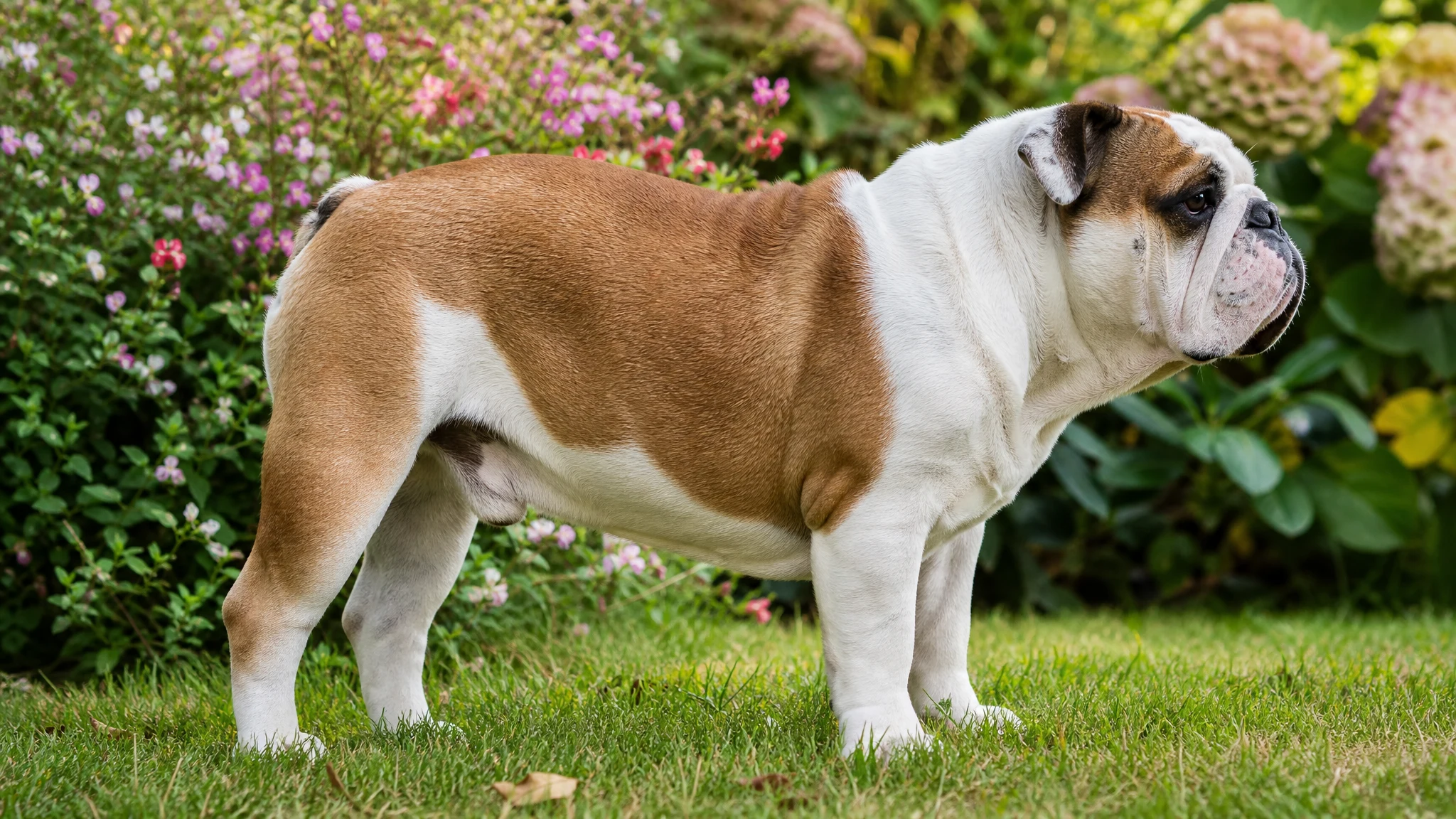
The Bulldog Club of America, in the AKC breed standard, describes a medium-sized dog of about 50 lb for mature males and about 40 lb for mature females. PetMD gives a similar range of roughly 40 to 50 lb and a life expectancy of 8 to 10 years.
PetMD also notes that the breed is prone to obesity, and that extra weight worsens other problems. Flat-faced anatomy can cause breathing difficulty and overheating, and extra weight makes those symptoms worse. Extra weight also aggravates hip dysplasia. A food does not prevent or treat any of these. But calories, portions and body condition are things you can manage, and the label is where that starts.
For a wider look at the diet factors involved, see English Bulldog nutrition and the diet factors that matter.
What you need before you start
- The food bag or can, or the brand's product page with the full label panel.
- Your dog's current weight and, ideally, your veterinarian's view of their ideal weight.
- Your dog's age in months.
- A list of any known skin or food sensitivities your vet has discussed with you.
- A kitchen measuring cup and a notepad, or a phone note, to compare foods side by side.
Step 1: Find the nutritional adequacy statement
Look for a sentence that says the food is formulated to meet the AAFCO Dog Food Nutrient Profiles, or that feeding tests substantiate it. It should also name a life stage: growth, maintenance, or all life stages.
Match this to your dog. A puppy needs a food labelled for growth or all life stages. An adult can eat a maintenance or all-life-stages food. A food with no such statement is not a complete diet.
Some statements differ in how they back the claim. Royal Canin's Bulldog Adult page says its food is formulated to meet the AAFCO nutrient profiles. Hill's Science Diet pages say animal feeding tests using AAFCO procedures substantiate their foods. Both are legitimate routes. The label tells you which one a brand used.
Step 2: Check the life stage and the age switch
Puppies and adults need different foods, but brands disagree on when to switch a Bulldog. Royal Canin's Bulldog Adult page describes its formula for Bulldogs 12 months and older. Its Bulldog Puppy page says to move to adult food after 15 months. Those are manufacturer guidelines, not a veterinary rule.
Ask your veterinarian when to change foods for your own dog, and follow the brand's transition directions when you do.
Step 3: Do not confuse "large breed" with your dog's size
This is a common point of confusion. Per Whole Dog Journal's explanation of AAFCO statements, the large-breed growth wording applies to dogs expected to reach 70 lb or more as adults. An English Bulldog at about 40 to 50 lb is well under that. Smaller-breed puppies can eat foods with or without the large-size wording.
Some foods carry "large breed" in the name for other reasons. Hill's Science Diet Adult Large Breed foods, for example, are labelled for adults of 55 lb or more. They are not made for Bulldogs. You may see them mentioned in Bulldog discussions because of weight management or joint interest, but treat them as size-adjacent, and ask your vet before choosing one.
Step 4: Read the guaranteed analysis carefully
The guaranteed analysis lists minimum protein and fat and maximum fiber, as fed. It is not the same on every product page, so check the basis before comparing.
As a real example, Royal Canin's Bulldog Adult dry food lists 22.0% protein minimum, 12.0% fat minimum and 4.1% fiber maximum, as fed. Its Bulldog Puppy dry food lists 28.0% protein, 15.0% fat and 4.0% fiber. The Hill's pages publish dry-matter average nutrient content instead, not guaranteed minimums. So Hill's Adult Perfect Weight Large Breed shows 28.8% protein, 11.2% fat and 10.3% fiber on a dry-matter basis. Those numbers cannot be lined up directly against an as-fed table.
Wet and fresh foods add another trap. Water makes their as-fed percentages look small. Royal Canin's French Bulldog Loaf lists 6.7% protein as fed, which says little until you account for moisture. Compare like with like, or ask the brand for dry-matter figures.
Step 5: Compare calories, not just ingredients
Because the breed is prone to obesity, calorie density deserves as much attention as protein. Look for kcal per cup, per can or per pouch. They are not interchangeable.
- Royal Canin Bulldog Adult: 277 kcal ME per cup, as fed (calculated).
- Hill's Science Diet Adult Perfect Weight Large Breed: 289 kcal per cup.
- Hill's Science Diet Adult Large Breed No Corn, Wheat, Soy: 390 kcal per cup.
- Freshpet Home Cooked Chicken Recipe: 189 kcal per cup (calculated).
Two cups of one food and two cups of another can differ by a lot of calories. That is why the cup count on a feeding table means nothing until you know the kcal per cup behind it.
Step 6: Read the first five ingredients without overreading them
Ingredients are listed by weight before cooking. The first five give a rough picture. Royal Canin Bulldog Adult lists brewers rice, oat groats, chicken by-product meal, brown rice and wheat gluten. Hill's Science Diet Adult Perfect Weight Large Breed lists chicken, cracked pearled barley, brown rice, pea fiber and corn protein meal.
Do not treat a long list as proof of quality, and do not treat by-products or grains as automatically bad. Be skeptical of marketing words like "premium" or "natural" that carry no label meaning. If your dog has a suspected food allergy, PetMD notes that some dogs need a special diet to manage it. That is a decision for your veterinarian, who may recommend a diet trial or a prescription food.
Step 7: Use the feeding guide as a starting point
Every brand gives a feeding table. Treat it as a starting amount, not a target. PetMD advises basing portions on a Bulldog's ideal weight, feeding adults twice daily, and keeping treats to no more than 10% of daily calories. It also says slow-feeder bowls can slow eating.
Hill's own pages say to adjust amounts as necessary to maintain optimal weight and to ask your veterinarian if unsure. Weigh your dog regularly, feel for ribs under a light layer of fat, and adjust in small steps.
Step 8: Be careful with grain-free and trendy diets
The FDA investigated a possible link between certain diets and canine dilated cardiomyopathy (DCM). Its last public update was December 23, 2022, and the agency said report counts alone do not establish a causal link. FDA does not plan more public updates until there is meaningful new scientific information.
So there is no clean answer to hand you here. If you are considering a grain-free or boutique food, talk to your vet and check the FDA page for any changes.
Tips
- Compare at least three foods in the same form (dry with dry, wet with wet) on one sheet.
- Write down kcal per cup and the as-fed or dry-matter basis for each.
- Change foods gradually, following the brand's directions.
- Count treats and chews in the day's calories.
- Keep skin folds clean and dry. PetMD says moisture in folds encourages infection, and that is a care issue, not a diet one.
Common mistakes
- Choosing by breed name alone. A Bulldog formula still needs to match your dog's age, weight and health. Royal Canin's French Bulldog loaf, for instance, is a French Bulldog formula, not an English Bulldog one.
- Comparing percentages on different bases. As-fed and dry-matter numbers are not the same thing.
- Feeding by the cup count on the table alone. Calories per cup vary widely.
- Picking large-breed food because Bulldogs look big. They are a medium breed.
- Expecting a food to fix a medical issue. Only your veterinarian can decide on a therapeutic or prescription diet.
What results to expect
A well-matched food, fed at a sensible portion, may help you keep your dog at a lean, healthy body weight. That is generally easier on the joints and breathing than extra weight, according to PetMD. You may notice steady energy and regular stools. Results vary from dog to dog, and no food can promise a particular health outcome.
If your dog gains or loses weight unexpectedly, scratches more, or has digestive upset after a change, check with your veterinarian before switching again.
Sources
- Bulldog Club of America, AKC Bulldog Breed Standard
- PetMD, Bulldog breed page
- Whole Dog Journal, In the Fine Print: Nutritional Adequacy Statements
- FDA CVM, Investigation into Potential Link between Certain Diets and Canine Dilated Cardiomyopathy
- Royal Canin US, Bulldog Adult product page
- Royal Canin US, Bulldog Puppy product page
- Royal Canin US, French Bulldog Loaf In Sauce product page
- Hill's Pet, Science Diet Adult Perfect Weight Large Breed
- Hill's Pet, Science Diet Adult Large Breed No Corn, Wheat, Soy
- Freshpet, Fresh From the Kitchen Home Cooked Chicken Recipe