Good Food for English Bulldogs on Any Budget
General nutrition information compiled from product labels and published sources, not veterinary advice. Your veterinarian is the right person to choose a diet for your dog, especially one with a health condition.
Good food for English Bulldogs is not defined by a price tag or a front-of-bag slogan. It is a complete and balanced diet, fed in amounts that keep a stocky, flat-faced dog lean. That goal can be met at many price points.
This guide walks through a label-first method you can use with any brand. We compared label data from a handful of brands to show how the method works. We did not run feeding trials or taste tests, and we are not ranking foods.
Why weight matters so much for this breed
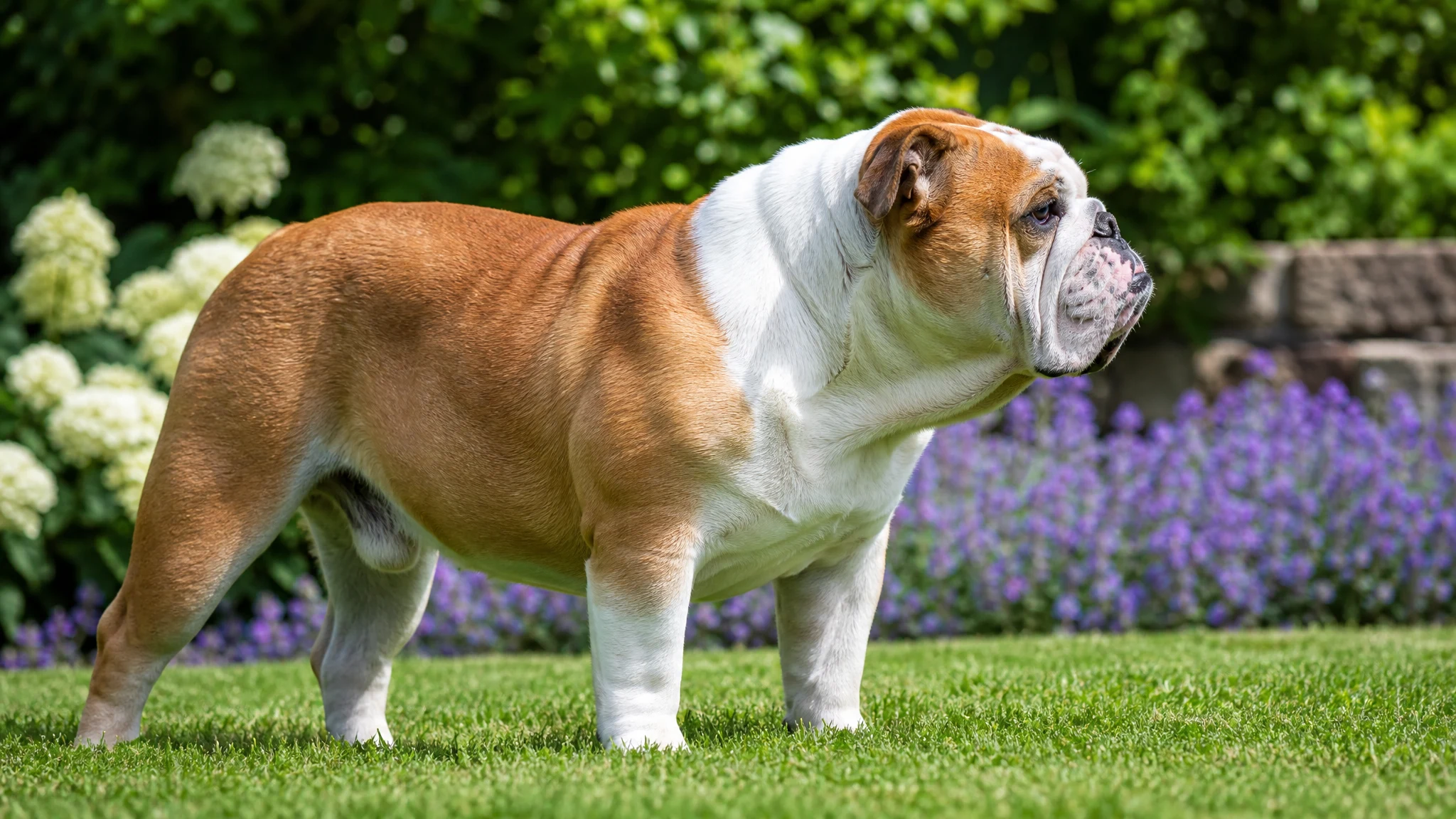
The Bulldog Club of America, through the AKC breed standard, describes a medium breed. Mature dogs weigh about 50 lb and mature bitches about 40 lb. PetMD gives a similar range of roughly 40 to 50 lb.
PetMD also lists several diet-related concerns for the breed. Bulldogs are prone to obesity, and extra weight worsens other conditions. Flat-faced anatomy can cause breathing difficulty and overheating, and PetMD notes that excess weight makes those symptoms worse. Extra weight also aggravates hip dysplasia.
So the budget question is really two questions. Is the food complete and balanced? And can you feed the right amount of it? For more on the diet factors involved, see English Bulldog nutrition and the diet factors that matter.
What you need
- The bag, can or tray label, or the brand's product page for the food you are considering
- Your dog's current weight and your veterinarian's view of his or her ideal weight
- A standard measuring cup, or a kitchen scale
- A notebook or phone note to record cups per day and monthly weight checks
- A slow feeder bowl, optional. PetMD says these can slow eating.
Step 1: Start with your dog's life stage
Decide whether you are shopping for a puppy or an adult. The brand-published age cutoffs vary, and Royal Canin shows this clearly. Its Bulldog Adult page describes the formula for Bulldogs 12 months and older. Its Bulldog Puppy page says to move to the adult food after 15 months.
Both are manufacturer guidance, not a veterinary or breed club rule. Ask your veterinarian when your own dog should switch.
Step 2: Find the nutritional adequacy statement
This sentence is the single most useful line on any label. It says whether the food is formulated to meet the AAFCO Dog Food Nutrient Profiles, and for which life stage: growth, maintenance or all life stages.
Some labels instead say the food was proven by animal feeding tests using AAFCO procedures. Hill's Science Diet uses that wording on its adult formulas. Either type of statement is a baseline for completeness. Neither tells you the food suits your individual dog.
A food with no such statement is a treat or a topper, not a main diet. That holds at every price.
Step 3: Ignore the large-breed label for adults
Whole Dog Journal explains the AAFCO wording for growth foods. A food labelled for growth "including growth of large-size dogs (70 pounds or more as an adult)" suits large-breed puppies. Smaller-breed puppies can eat either type.
English Bulldogs are about 40 to 50 lb as adults, so that large-size rule does not apply to them. Large-breed foods are not made for Bulldogs. Hill's Science Diet Large Breed adult foods are labelled for dogs of 55 lb or more as adults. Do not pay extra for a "large breed" label on the assumption that it suits a Bulldog better.
Step 4: Compare labels on the same basis
Put two or three candidate foods side by side. Check protein, fat, fiber, calories per cup and the first few ingredients. The trap is mixing bases. Some brands list as-fed analysis, which includes moisture. Hill's publishes dry-matter averages instead. Those are averages, not minimums or maximums.
A canned or fresh food will always look low in protein as fed because it contains a lot of water. Compare like with like, or compare calories, which matter most for weight control.
| Food (brand page) | Form | Protein / fat / fiber | Calories |
|---|---|---|---|
| Royal Canin Bulldog Adult | Dry | 22% min / 12% min / 4.1% max, as fed | 277 kcal ME per cup |
| Hill's Science Diet Adult Perfect Weight Large Breed | Dry | 28.8% / 11.2% / 10.3%, dry matter averages | 289 kcal per cup |
| Freshpet Fresh From the Kitchen Home Cooked Chicken | Fresh | 15% min / 11% min / 1% max, as fed | 189 kcal per cup |
Notice how different the calorie counts per cup are. The same scoop of two foods can deliver very different energy. Pricing varies by store and region, so check with each brand for current costs.
Royal Canin's French Bulldog Loaf In Sauce is a wet food made for another flat-faced breed. It is not an English Bulldog formula, and we mention it only so you do not mistake it for one.
Step 5: Read the first five ingredients
Ingredient lists are ordered by weight before cooking. Royal Canin's Bulldog Adult lists brewers rice, oat groats, chicken by-product meal, brown rice and wheat gluten first. Hill's Perfect Weight Large Breed lists chicken, cracked pearled barley, brown rice, pea fiber and corn protein meal.
Neither list is automatically better. Marketing words like "premium" and "natural" do not appear in the nutrient profiles. Grain-free is also not a quality mark on its own.
The FDA investigated a possible link between certain diets and canine dilated cardiomyopathy (DCM). Its last public update was December 23, 2022. The FDA says report counts alone do not establish a causal link, and it does not plan further public updates until there is meaningful new scientific information. If you are weighing a grain-free diet, discuss it with your veterinarian.
Step 6: Use the feeding guide as a starting point
Every label has a feeding guide. Treat it as a first estimate, not a prescription. Royal Canin's Bulldog Adult table, for example, lists a 40 lb dog at low activity at 2 7/8 cups (219 g) per day. Your dog may need more or less.
Hill's tells owners to adjust amounts as necessary to maintain optimal weight and to ask a veterinarian if unsure. PetMD advises basing portions on ideal weight, not current weight, and feeding adults twice daily.
Measure every meal. Eyeballing a scoop is the quickest way to overfeed a dog that is already prone to weight gain.
Step 7: Budget the extras too
Treats are part of the diet. PetMD says treats should be no more than 10% of daily calories. If you give treats, take that amount out of the meal. Small pieces of the dog's own kibble can work as training rewards.
Fresh and wet foods can be used as toppers or full meals, but follow each brand's own feeding guide. Freshpet, for example, says its amounts depend on the dog's weight. Some fresh brands state that full-meal feeding follows their own daily guide, so do not combine guides without asking the brand or your veterinarian.
Step 8: Weigh, adjust and recheck
Weigh your dog monthly and write it down. If weight creeps up, reduce the daily amount in small steps and tell your veterinarian. Do not cut calories sharply on your own.
Changing foods should be gradual, mixing old and new over several days. Ask your veterinarian or the brand for its suggested transition.
Common mistakes to avoid
- Judging by price alone. A costly food fed too generously can still lead to weight gain.
- Comparing protein across wet, fresh and dry foods. The moisture content makes the numbers incomparable.
- Feeding to the current weight. If your dog is heavy, portions should follow the ideal weight.
- Counting treats as free. They add up quickly in a small-framed dog.
- Expecting food to fix a medical issue. Allergies and skin problems can have environmental, food or flea causes, and PetMD says some dogs need a special diet to manage them. That diet is a decision for your veterinarian, and prescription diets come only from a veterinarian.
- Forgetting skin folds. PetMD notes that moisture trapped in facial and body folds encourages infection. That is a cleaning issue, not a food issue.
What to expect
With a complete and balanced food, measured portions and regular weigh-ins, many owners find it easier to keep a Bulldog at a healthy weight. A lean dog may breathe more comfortably and put less load on the joints. PetMD links excess weight to worse airway symptoms and aggravated hip dysplasia.
Results vary from dog to dog, and no food prevents, treats or cures a condition. PetMD gives a typical life expectancy of 8 to 10 years for the breed. Your veterinarian can tell you what a healthy weight and diet look like for your dog.
Sources
- Bulldog Club of America, AKC Bulldog Breed Standard
- PetMD, Bulldog breed page
- Whole Dog Journal, In the Fine Print: Nutritional Adequacy Statements
- FDA CVM, Investigation into Potential Link between Certain Diets and Canine Dilated Cardiomyopathy
- Royal Canin US, Bulldog Adult
- Royal Canin US, Bulldog Puppy
- Hill's Pet, Science Diet Adult Perfect Weight Large Breed
- Freshpet, Fresh From the Kitchen Home Cooked Chicken Recipe